Abstract
Software maintenance is often a long and costly phase of the software lifecycle, encompassing activities such as defect correction, adaptation, code improvement, and functionality enhancement. Conceptual inconsistencies and terminological variation continue to hinder effective communication among researchers and practitioners. To address this gap, this paper presents the Software Maintenance Top-Domain Ontology (SwMaintTDO), a high-domain ontology developed within a five-tier ontological architecture. This ontology was constructed using competency questions, ontological analysis of documented maintenance processes, artifacts, and resources, and alignment with established software engineering standards. SwMaintTDO provides a unified and extensible conceptual model for representing key maintenance processes, roles, resources, artifacts, goal purposes, and the transition of target modifiable and context entities from current to updated maintenance situations. The applicability and value of SwMaintTDO are demonstrated through its application -via its concepts and relationships- to the process specification of a corrective maintenance strategy.
Analysis
AI-generated · verify against the original paper
Generated Jan 1, 0001ResultsWhat the authors found
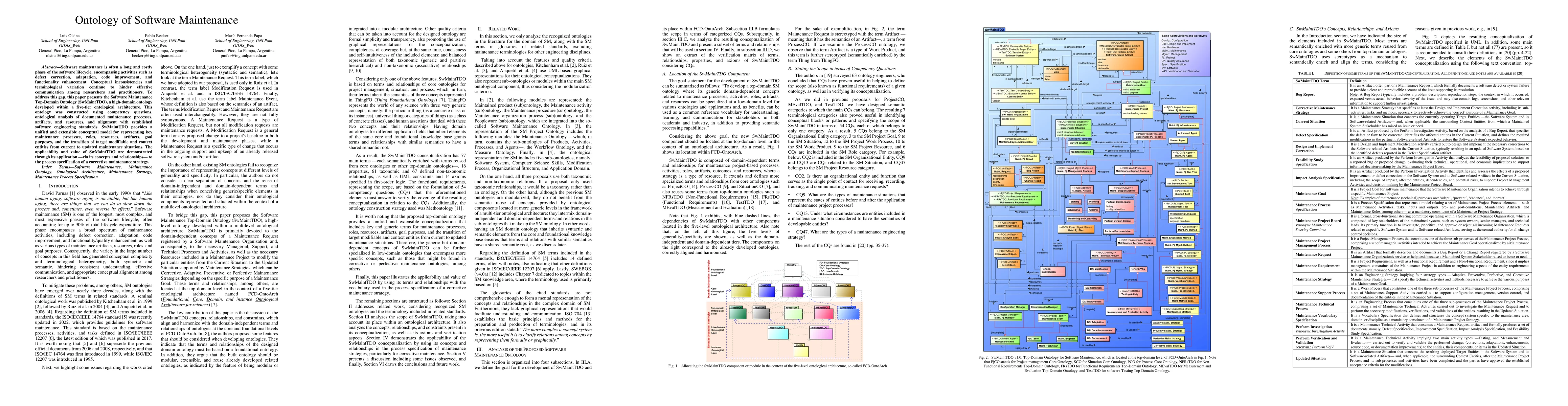
- SwMaintTDO comprises 77 main terms, 16 properties, 61 taxonomic and 67 non‑taxonomic relationships, plus UML constraints and 14 first‑order logic axioms.
- The ontology was verified against 54 competency questions to ensure coverage of maintenance concepts.
- Application of SwMaintTDO to a corrective maintenance process specification demonstrated its practical usefulness and terminological consistency.
LimitationsWhere the findings need caution
- The current work only includes the top‑domain ontology; low‑domain ontologies for specific maintenance strategies are still under development.
- Empirical validation beyond the illustrative corrective maintenance case study is not presented.
MethodologyHow the work was done
The ontology was built using competency questions, ontological analysis of documented maintenance processes, artifacts, and resources, alignment with ISO/IEC/IEEE standards, and the Methontology engineering method, all within a five-tier ontological architecture (FCD-OntoArch).
SignificanceWhy the work matters
SwMaintTDO provides a unified, extensible conceptual model that harmonizes domain‑dependent maintenance concepts with core and foundational ontologies, reducing terminological heterogeneity and improving communication among researchers and practitioners.
Technical contributionsWhat the work introduces
A high‑level software maintenance ontology (SwMaintTDO) that integrates 77 concepts, extensive taxonomic and associative relationships, constraints, and axioms, aligned with standards and reusable within a multilevel ontological framework.
NoveltyHow it differs from prior work
Introduction of a top‑domain maintenance ontology situated in a five‑tier architecture that reuses core and foundational ontology elements, addressing prior ontologies' lack of modularity, semantic reuse, and clear separation of generic and specific concepts.
Future workQuestions that remain
- Develop CorMaintLDO, a corrective maintenance ontology with more detailed terms and relationships.
- Create and evaluate low‑domain ontologies for perfective maintenance and other maintenance strategies such as adaptive and preventive maintenance.
- Further empirical assessment of SwMaintTDO’s impact on maintenance process specification and tool support.
Discussion 0