Open CDLM: A Benchmark and Library for Continuous Diffusion Language Models
Abstract
Reliable comparisons of continuous diffusion language models (CDLMs) require evaluating both model fit and the distribution of generated text. Two common practices leave this goal only partially addressed. Likelihood-based evaluation often reports a variational upper bound on discrete negative log-likelihood, whose slack can confound comparisons. Generated-sample-based evaluation commonly combines generative perplexity with within-sequence unigram entropy; both scores can remain favorable even when a sampler produces the same text on every draw. We introduce \textbf{Open CDLM}, a benchmark for evaluating CDLMs and their samplers, and describe the design of an accompanying open-source library to support reproducible comparisons. For likelihood-based evaluation, we clarify which comparisons of model fit are supported by reported perplexity bounds and how those conclusions depend on the evaluation procedure. For sample-based evaluation, we use \textit{Kernel Text Discrepancy} (\textbf{KTD}) to compare collections of generated and real texts, alongside diagnostics for diversity, validity, and coverage. In controlled OpenWebText experiments, replacing a collection of texts with copies of a single selected passage improves both conventional generation scores. MAUVE detects the resulting collapse, and its response to other perturbations depends on the text representation and the type of perturbation. This work marks the beginning of Open CDLM as an open-source project for CDLM research. We will maintain and extend the library over time and welcome contributions from the community.
Analysis
AI-generated · verify against the original paper
Generated Jan 1, 0001ResultsWhat the authors found
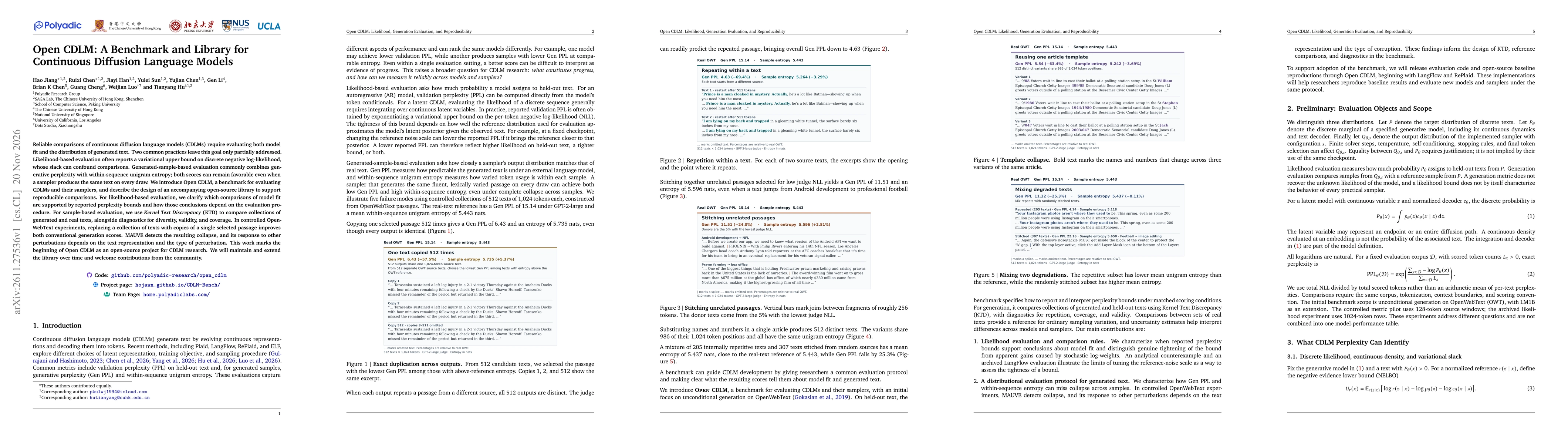
- Copying a single selected passage 512 times dramatically lowers generative perplexity (GenPPL drops from 15.14 to 6.43) while slightly increasing unigram entropy, yet the samples are identical.
- MAUVE detects the collapse caused by exact duplication, whereas conventional scores can remain favorable.
- KTD provides a more sensitive measure of distributional mismatch between real and generated texts.
- Clustering and representation choices strongly affect MAUVE scores; increasing cluster count reduces MAUVE for duplicated samples.
- The benchmark reports computational costs (≈7 s for MAUVE clustering, 15–17 s for feature extraction on 512 texts).
LimitationsWhere the findings need caution
- Evaluations rely on variational upper bounds whose tightness varies with the reference noise scale, potentially confounding perplexity comparisons.
- Detection of rare errors is limited by sample size; events with probability 0.001 may be absent from 512 independent outputs.
- Current experiments are confined to controlled OpenWebText manipulations and may not cover all real‑world generation scenarios.
MethodologyHow the work was done
The authors design Open CDLM, an open‑source benchmark and library that (1) clarifies how variational upper bounds on discrete negative log‑likelihood affect perplexity comparisons for continuous diffusion language models, and (2) introduces Kernel Text Discrepancy (KTD) together with diversity, validity, and coverage diagnostics to evaluate generated‑sample distributions. Controlled experiments on OpenWebText compare standard generation metrics (GenPPL, unigram entropy) with KTD and MAUVE under manipulations such as copying a single passage many times.
SignificanceWhy the work matters
Open CDLM offers the first systematic, reproducible framework for jointly assessing model fit and sample quality in continuous diffusion language models, addressing ambiguities in likelihood‑based evaluation and exposing failure modes that conventional metrics miss.
Technical contributionsWhat the work introduces
A publicly available benchmark suite and Python library that standardizes likelihood evaluation (with clarified perplexity bounds) and sample‑based evaluation (using KTD, MAUVE, and diversity/validity metrics), together with reproducible pipelines for data preprocessing, feature extraction, and cost reporting.
NoveltyHow it differs from prior work
The work uniquely combines a theoretical analysis of variational perplexity bounds with a practical, kernel‑based discrepancy measure for text, providing the first comprehensive, open‑source evaluation platform tailored to continuous diffusion language models.
Future workQuestions that remain
- Extend the library with additional diagnostics and support for new CDLM architectures.
- Incorporate larger and more diverse text corpora to evaluate robustness of KTD and MAUVE across domains.
- Improve variance reduction techniques for likelihood bounds and explore tighter evaluation procedures.
Discussion 0