OpenBrain: An Auditable Generated-Label Release for Whole-Brain MRI Parcellation
Abstract
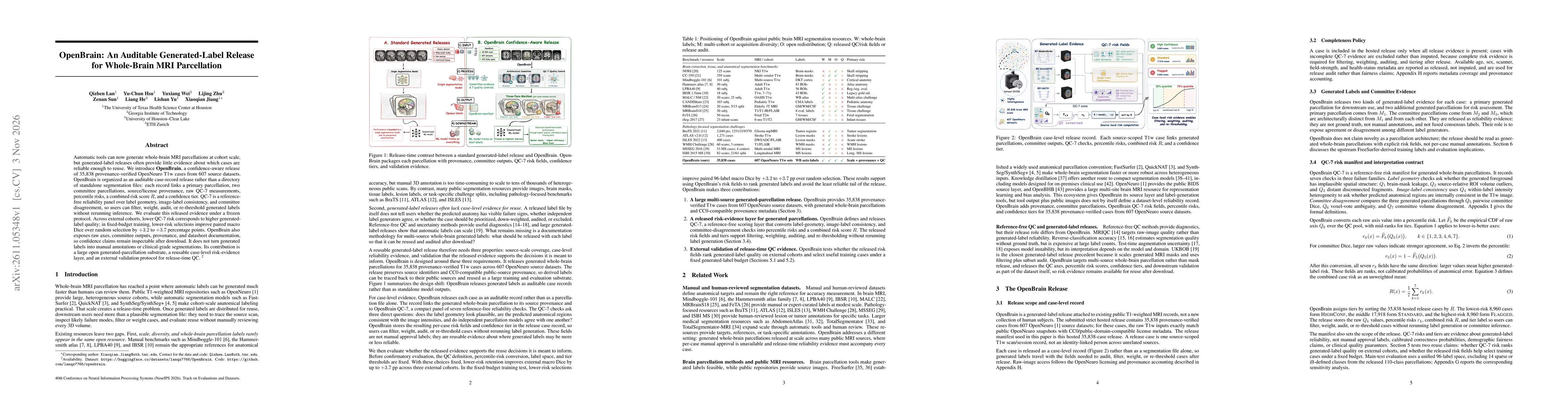
Automatic tools can now generate whole-brain MRI parcellations at cohort scale, but generated-label releases often provide little evidence about which cases are reliable enough to reuse. We introduce OpenBrain, a confidence-aware release of 35,838 provenance-verified OpenNeuro T1w cases from 607 source datasets. OpenBrain is organized as an auditable case-record release rather than a directory of standalone segmentation files: each record links a primary parcellation, two committee parcellations, source/license provenance, raw QC-7 measurements, percentile risks, a combined risk score R, and a confidence tier. QC-7 is a reference-free reliability panel over label geometry, image-label consistency, and committee disagreement, so users can filter, weight, audit, or re-threshold generated labels without rerunning inference. We evaluate this released evidence under a frozen protocol. Across external cohorts, lower QC-7 risk corresponds to higher generated-label quality; in fixed-budget training, lower-risk selections improve paired macro Dice over random selection by +3.2 to +3.7 percentage points. OpenBrain also exposes raw axes, committee outputs, provenance, and datasheet documentation, so confidence claims remain inspectable after download. It does not turn generated labels into manual annotations or clinical-grade segmentations. Its contribution is a large open generated-parcellation substrate, a reusable case-level risk-evidence layer, and an external validation protocol for release-time QC. Dataset: https://huggingface.co/datasets/lanqz7766/OpenBrain. Code: https://github.com/lanqz7766/openbrain.
Analysis
AI-generated · verify against the original paper
Generated Jan 1, 0001ResultsWhat the authors found
- Across external cohorts, lower QC‑7 risk scores correspond to higher generated‑label quality.
- In fixed‑budget training experiments, selecting lower‑risk cases improves paired macro Dice over random selection by +3.2 to +3.7 percentage points.
- Risk scores reveal demographic and acquisition‑related offsets, enabling stratified audits of the release.
LimitationsWhere the findings need caution
- The released labels are not manual annotations nor clinical‑grade segmentations.
- Demographic and health‑status metadata are sparse, limiting fairness claims.
- Selection arms alter subgroup composition, so random‑pool results must be interpreted as primary.
MethodologyHow the work was done
OpenBrain releases 35,838 provenance‑verified whole‑brain MRI parcellations as auditable case records, each linking a primary segmentation, two committee segmentations, source/license provenance, raw QC‑7 measurements (seven reference‑free reliability checks on label geometry, image‑label consistency, and committee disagreement), percentile risks, a combined risk score R, and a confidence tier; evaluation follows a frozen protocol comparing risk scores to external label quality and training performance.
SignificanceWhy the work matters
OpenBrain provides a large, openly available generated‑label substrate with case‑level reliability evidence, allowing downstream users to filter, weight, and audit labels without re‑running inference, thereby improving the trustworthiness and utility of cohort‑scale MRI parcellations.
Technical contributionsWhat the work introduces
A large open generated‑parcellation dataset with per‑case provenance, QC‑7 risk fields, confidence tiers, and an external validation protocol for release‑time quality control.
NoveltyHow it differs from prior work
First auditable case‑record release for whole‑brain MRI parcellations that integrates reference‑free QC metrics and risk scores to enable post‑download inspection and selective reuse.
Discussion 0