OpenGait: Revisiting Gait Recognition Toward Better Practicality
This paper presents OpenGait, a comprehensive benchmark study aimed at improving the practicality of gait recognition techniques. It develops a simple yet robust baseline model, GaitBase, and demonstrates its superior performance across various datasets, highlighting the importance of real-world applicability over indoor dataset performance.
Abstract
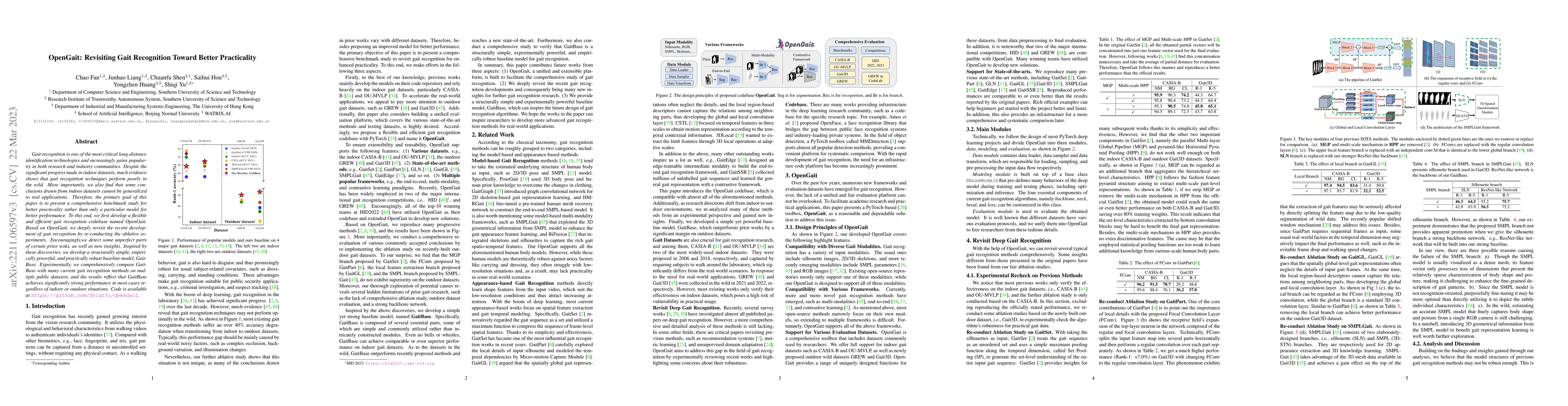
Gait recognition is one of the most critical long-distance identification technologies and increasingly gains popularity in both research and industry communities. Despite the significant progress made in indoor datasets, much evidence shows that gait recognition techniques perform poorly in the wild. More importantly, we also find that some conclusions drawn from indoor datasets cannot be generalized to real applications. Therefore, the primary goal of this paper is to present a comprehensive benchmark study for better practicality rather than only a particular model for better performance. To this end, we first develop a flexible and efficient gait recognition codebase named OpenGait. Based on OpenGait, we deeply revisit the recent development of gait recognition by re-conducting the ablative experiments. Encouragingly,we detect some unperfect parts of certain prior woks, as well as new insights. Inspired by these discoveries, we develop a structurally simple, empirically powerful, and practically robust baseline model, GaitBase. Experimentally, we comprehensively compare GaitBase with many current gait recognition methods on multiple public datasets, and the results reflect that GaitBase achieves significantly strong performance in most cases regardless of indoor or outdoor situations. Code is available at https://github.com/ShiqiYu/OpenGait.
AI Key Findings
Get AI-generated insights about this paper's methodology, results, significance, and more — available when analysis has been generated.
Discussion 0