Optimization of Piezo Operation for Superconducting TESLA Cavities at EuXFEL
Abstract
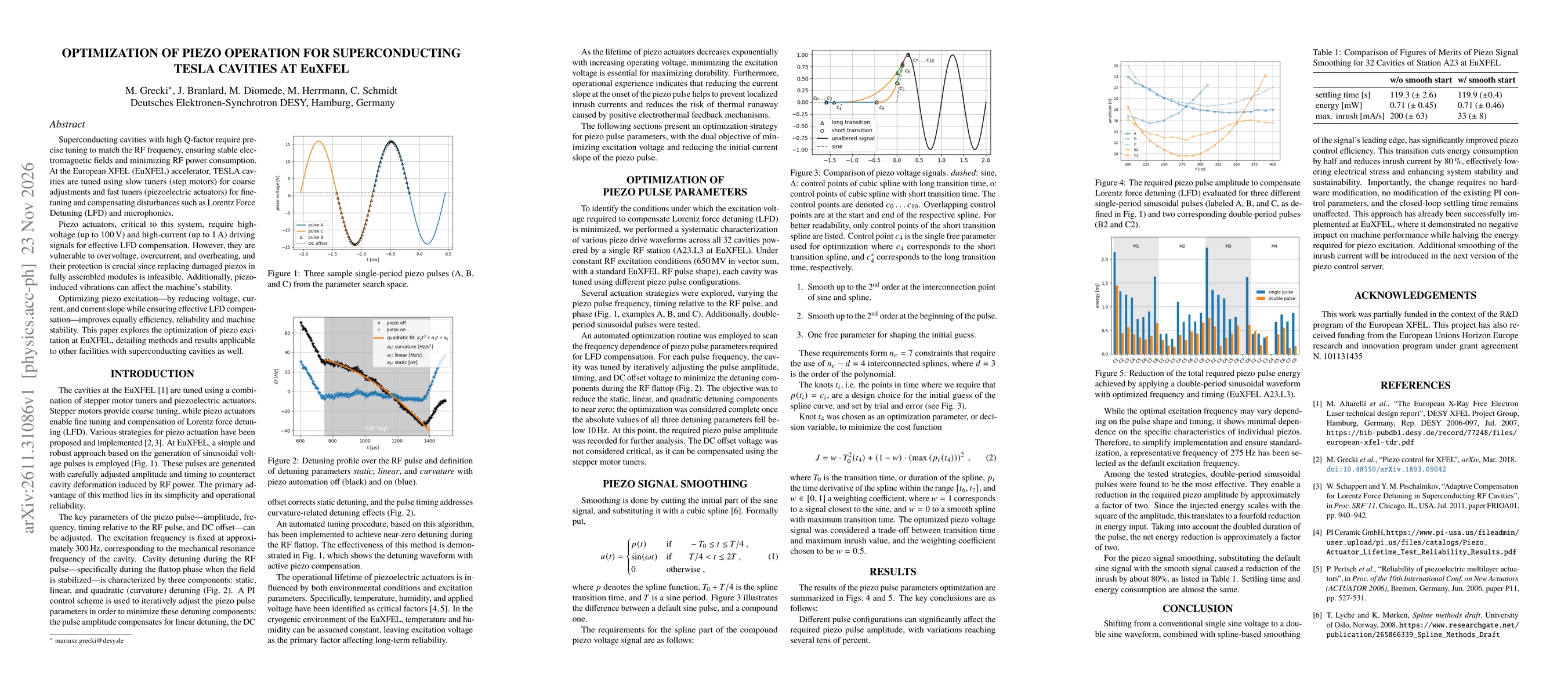
Superconducting cavities with high-Q factor require precise tuning to match the RF frequency, ensuring stable electromagnetic fields and minimizing RF power consumption. At the European XFEL (EuXFEL) accelerator, TESLA cavities are tuned using slow tuners (step motors) for coarse adjustments and fast tuners (piezoelectric actuators) for fine-tuning and compensating disturbances such as Lorentz Force Detuning (LFD). Piezo actuators, critical to this system, require high-voltage (up to 100V) and high-current (up to 1A) driving signals for effective LFD compensation. However, they are vulnerable to overvoltage, overcurrent, and overheating, and their protection is crucial since replacing damaged piezos in fully assembled modules is infeasible. Additionally, piezo-induced vibrations can affect the machine's stability. Optimizing piezo excitation, by reducing voltage, current, and current slope while ensuring effective LFD compensation, improves equally efficiency, reliability and machine stability. This paper explores the optimization of piezo excitation at EuXFEL, detailing methods and results applicable to other facilities with superconducting cavities as well.
Analysis
AI-generated · verify against the original paper
Generated Jan 1, 0001ResultsWhat the authors found
- Double‑period sinusoidal pulses reduced the required piezo amplitude by approximately a factor of two, leading to a fourfold reduction in injected energy and an overall net energy reduction of about a factor of two.
- Spline‑based smoothing of the pulse start reduced the inrush current by roughly 80% (from ~200 mA/s to ~33 mA/s) without affecting settling time or energy consumption.
- The optimized excitation frequency showed minimal dependence on individual piezo characteristics, allowing a standard frequency of 275 Hz to be adopted.
- The new excitation scheme halved the energy required for piezo operation while maintaining machine performance and stability.
LimitationsWhere the findings need caution
- The study was limited to the 32 cavities of a single RF station (A23.L3) at EuXFEL, so results may not directly extrapolate to other stations or cavity designs.
- Optimization focused on voltage amplitude and inrush current; other potential failure modes such as long‑term thermal cycling were not addressed.
MethodologyHow the work was done
A systematic characterization of piezo drive waveforms was performed on 32 TESLA cavities using an automated optimization routine that iteratively adjusted pulse amplitude, timing, and DC offset to minimize static, linear, and quadratic detuning components. Different sinusoidal pulse configurations (single‑period, double‑period) and spline‑based signal smoothing were tested, with the cost function balancing transition time and inrush current. The optimal excitation frequency of 275 Hz was selected for standardization.
SignificanceWhy the work matters
The optimization improves the reliability and longevity of piezo actuators, reduces electrical stress and power consumption, and enhances overall accelerator stability without requiring hardware modifications, making the approach applicable to other superconducting‑cavity facilities.
Technical contributionsWhat the work introduces
Introduces a combined double‑period sinusoidal excitation and spline‑based signal smoothing technique that reduces piezo drive voltage, energy input, and inrush current while preserving detuning compensation performance.
NoveltyHow it differs from prior work
The work demonstrates, for the first time in the EuXFEL context, that a simple change in pulse shape together with a mathematically optimized spline transition can achieve substantial reductions in piezo stress and power consumption without any hardware changes.
Future workQuestions that remain
- Implement additional smoothing of the inrush current in the next version of the piezo control server.
- Extend the optimization methodology to other RF stations and to different superconducting cavity designs to verify generality.
Discussion 0