Orbital evolution of asymmetric binaries within accreting environments
Abstract
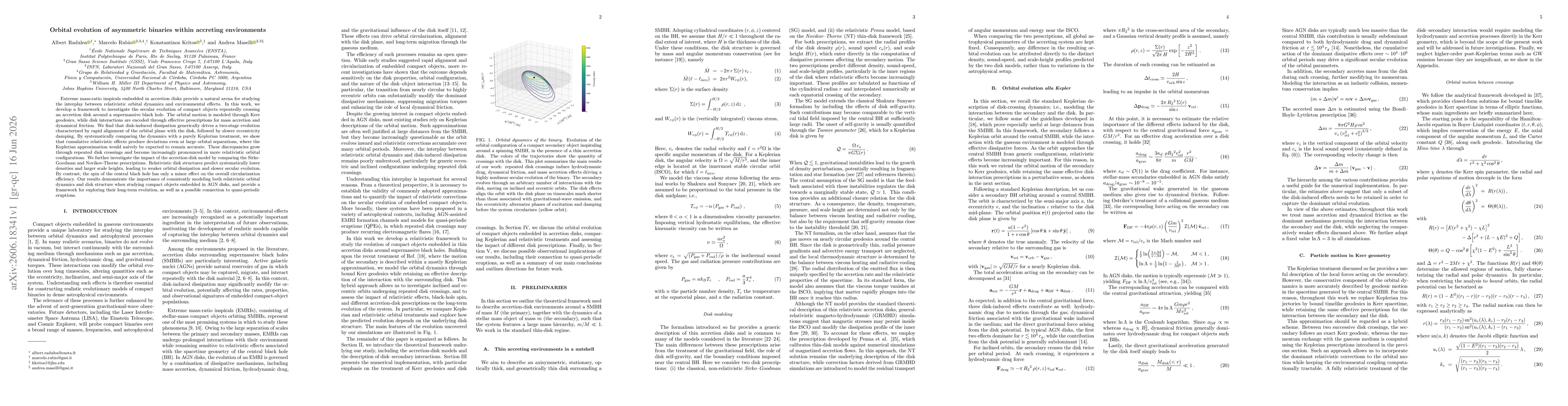
Extreme mass-ratio inspirals embedded in accretion disks provide a natural arena for studying the interplay between relativistic orbital dynamics and environmental effects. In this work, we develop a framework to investigate the secular evolution of compact objects repeatedly crossing an accretion disk around a supermassive black hole. The orbital motion is modeled through Kerr geodesics, while disk interactions are encoded through effective prescriptions for mass accretion and dynamical friction. We find that disk-induced dissipation generically drives a two-stage evolution characterized by rapid alignment of the orbital plane with the disk, followed by slower eccentricity damping. By systematically comparing the dynamics with a purely Keplerian treatment, we show that cumulative relativistic effects produce deviations even at large orbital separations, where the Keplerian approximation would naively be expected to remain accurate. These discrepancies grow through repeated disk crossings and become increasingly pronounced in more relativistic orbital configurations. We further investigate the impact of the accretion-disk model by comparing the Sirko-Goodman and Novikov-Thorne prescriptions. Relativistic disk structures predict systematically lower densities and larger scale heights, leading to weaker orbital dissipation and slower secular evolution. By contrast, the spin of the central black hole has only a minor effect on the overall circularization efficiency. Our results demonstrate the importance of consistently modeling both relativistic orbital dynamics and disk structure when studying compact objects embedded in AGN disks, and provide a framework for exploring their long-term evolution, as well as a possible connection to quasi-periodic eruptions.
AI Key Findings
Get AI-generated insights about this paper's methodology, results, significance, and more — available when analysis has been generated.
Discussion 0