Orthogonally Polarized Kerr Frequency Combs
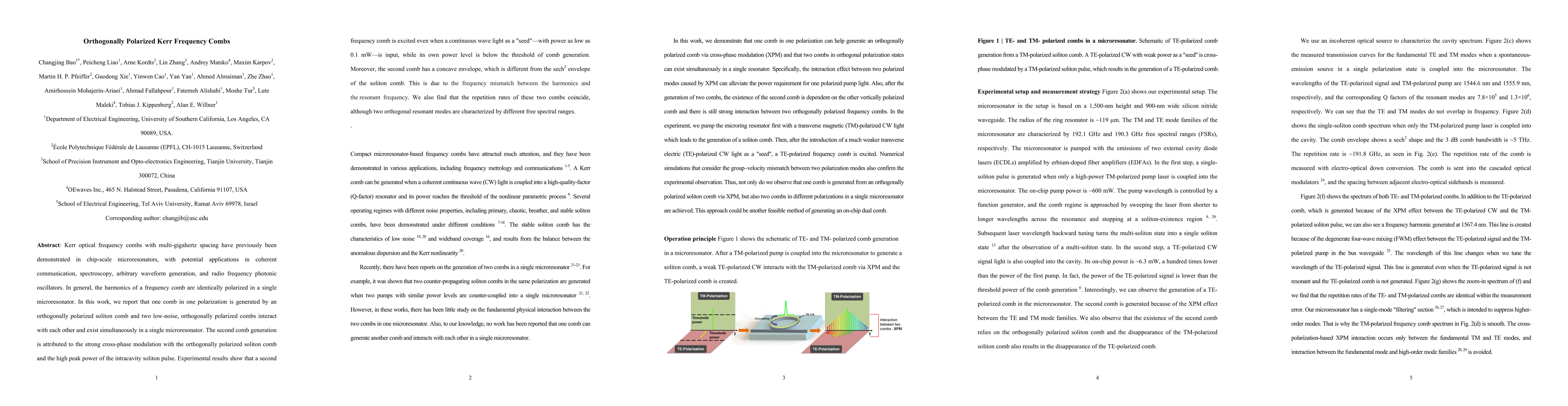
This paper demonstrates the generation of two orthogonally polarized Kerr frequency combs within a single microresonator, with one comb driven by an orthogonally polarized soliton comb. The second comb's generation is attributed to strong cross-phase modulation and high intracavity soliton pulse power, even from low-power continuous wave seeds.
Abstract
Kerr optical frequency combs with multi-gigahertz spacing have previously been demonstrated in chip-scale microresonators, with potential applications in coherent communication, spectroscopy, arbitrary waveform generation, and radio frequency photonic oscillators. In general, the harmonics of a frequency comb are identically polarized in a single microresonator. In this work, we report that one comb in one polarization is generated by an orthogonally polarized soliton comb and two low-noise, orthogonally polarized combs interact with each other and exist simultaneously in a single microresonator. The second comb generation is attributed to the strong cross-phase modulation with the orthogonally polarized soliton comb and the high peak power of the intracavity soliton pulse. Experimental results show that a second frequency comb is excited even when a continuous wave light as a "seed"-with power as low as 0.1 mW-is input, while its own power level is below the threshold of comb generation. Moreover, the second comb has a concave envelope, which is different from the sech2 envelope of the soliton comb. This is due to the frequency mismatch between the harmonics and the resonant frequency. We also find that the repetition rates of these two combs coincide, although two orthogonal resonant modes are characterized by different free spectral ranges.
AI Key Findings
Get AI-generated insights about this paper's methodology, results, significance, and more — available when analysis has been generated.
Discussion 0