This paper proposes a novel method using generative neural networks to create conditional geological realizations by extending a generative adversarial network with an additional inference network that conditions the generation on spatial observations. The approach demonstrates promising results in generating complex geological patterns that honor given spatial data.
Abstract
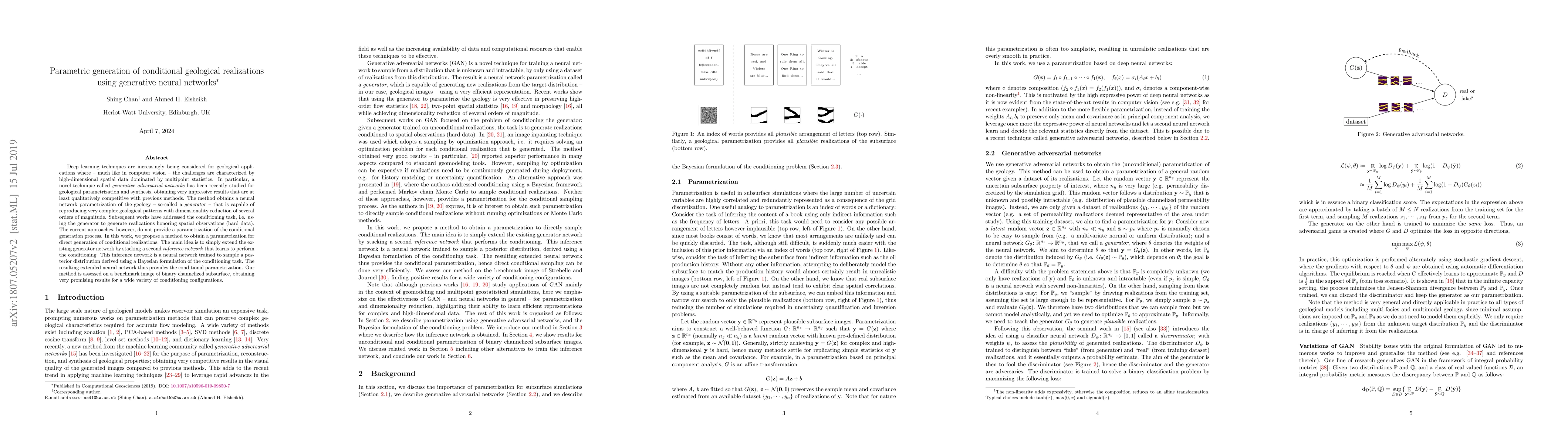
Deep learning techniques are increasingly being considered for geological applications where -- much like in computer vision -- the challenges are characterized by high-dimensional spatial data dominated by multipoint statistics. In particular, a novel technique called generative adversarial networks has been recently studied for geological parametrization and synthesis, obtaining very impressive results that are at least qualitatively competitive with previous methods. The method obtains a neural network parametrization of the geology -- so-called a generator -- that is capable of reproducing very complex geological patterns with dimensionality reduction of several orders of magnitude. Subsequent works have addressed the conditioning task, i.e. using the generator to generate realizations honoring spatial observations (hard data). The current approaches, however, do not provide a parametrization of the conditional generation process. In this work, we propose a method to obtain a parametrization for direct generation of conditional realizations. The main idea is to simply extend the existing generator network by stacking a second inference network that learns to perform the conditioning. This inference network is a neural network trained to sample a posterior distribution derived using a Bayesian formulation of the conditioning task. The resulting extended neural network thus provides the conditional parametrization. Our method is assessed on a benchmark image of binary channelized subsurface, obtaining very promising results for a wide variety of conditioning configurations.
AI Key Findings
Get AI-generated insights about this paper's methodology, results, significance, and more — available when analysis has been generated.
Discussion 0