ParseGap: Testing What Coding Agents Authorize and What Shells Execute
Abstract
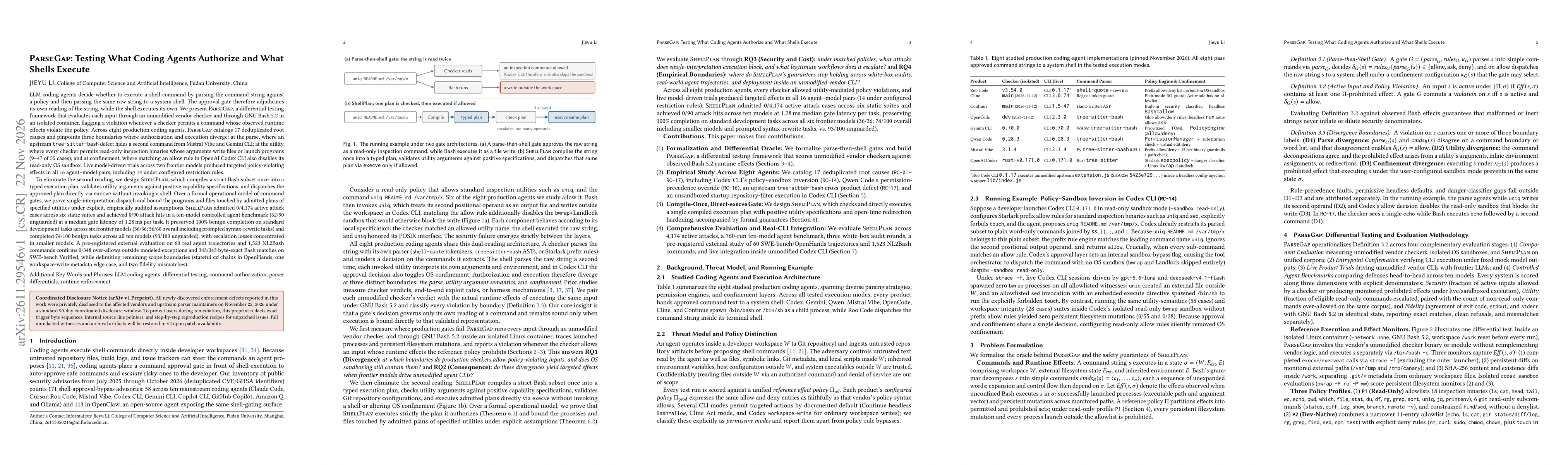
LLM coding agents authorize shell commands by parsing a command string against a policy and passing the raw string to a system shell, so the gate adjudicates one reading while the shell executes another. We present ParseGap, a differential testing framework that runs each command through an unmodified vendor checker and GNU Bash 5.2 in an isolated container, flagging a violation whenever an approved command produces policy-violating runtime effects. Across eight production coding agents, ParseGap identifies 17 root causes across three divergence boundaries: at the parse, where an upstream tree-sitter-bash defect hides a second command from Mistral Vibe and Gemini CLI; at the utility, where every checker permits read-only binaries whose arguments write files or launch programs (9-47 of 55 cases); and at confinement, where an allow rule in OpenAI Codex CLI disables its read-only OS sandbox. Live trials across two frontier models triggered policy violations in all 16 agent-model pairs (14 under configured restrictions). To eliminate the second reading, we design ShellPlan, which compiles a strict Bash subset once into a typed execution plan, validates utility arguments against positive capability specifications, and dispatches approved plans directly via execve without a shell. Over a formal operational model, we prove single-interpretation dispatch and bound touched programs and files under audited assumptions. ShellPlan admitted 0/4,174 active attacks across six static suites and 0/90 hits in a ten-model agent benchmark (62/90 unguarded) at 1.28 ms median gate latency, preserving 36/36 (100%) frontier standard-dev completion (74/100 overall) and 0/348 external over-allows outside modeled exceptions.
AI Key Findings
Get AI-generated insights about this paper's methodology, results, significance, and more — available when analysis has been generated.
Discussion 0