Parsing Visual Latents for Multimodal Spatial Reasoning
Abstract
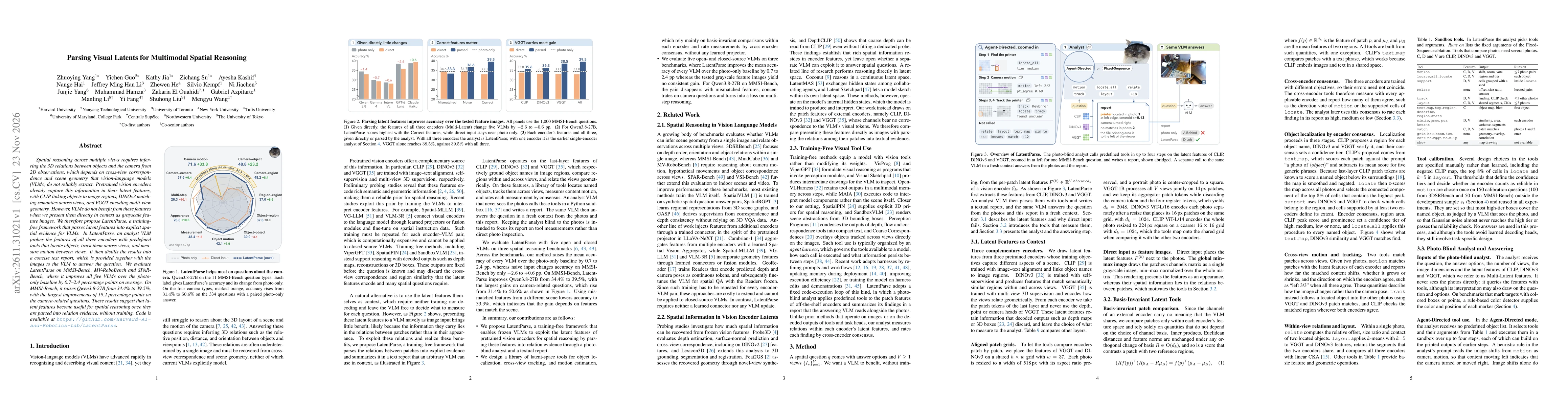
Spatial reasoning across multiple views requires inferring the 3D relations between objects and the camera from 2D observations, which depends on cross-view correspondence and scene geometry that vision-language models (VLMs) do not reliably extract. Pretrained vision encoders already capture this information in their latent features, with CLIP linking objects to image regions, DINOv3 matching semantics across views, and VGGT encoding multi-view geometry. However, VLMs do not benefit from these features when we present them directly in context as grayscale feature images. We therefore propose LatentParse, a training-free framework that parses latent features into explicit spatial evidence for VLMs. In LatentParse, an analyst VLM probes the features of all three encoders with predefined tools that locate objects, track them across views, and measure motion between views. It then distills the results into a concise text report, which is provided together with the images to the VLM to answer the question. We evaluate LatentParse on MMSI-Bench, MV-RoboBench and SPAR-Bench, where it improves all five VLMs over the photo-only baseline by 0.7-2.4 percentage points on average. On MMSI-Bench, it raises Qwen3.8-27B from 34.4% to 39.5%, with the largest improvements of 19.2 percentage points on the camera-related questions. These results suggest that latent features become useful for spatial reasoning once they are parsed into relation evidence, without training. Code is available at https://github.com/Harvard-AI-and-Robotics-Lab/LatentParse.
Analysis
AI-generated · verify against the original paper
Generated Jan 1, 0001ResultsWhat the authors found
- Across MMSI‑Bench, MV‑RoboBench, and SPAR‑Bench, LatentParse improves the mean accuracy of five VLMs over the photo‑only baseline by 0.7–2.4 percentage points.
- For Qwen3.8‑27B on MMSI‑Bench, overall accuracy rises from 34.4% to 39.5%, with the largest gain of 19.2 points on camera‑related questions (31.4% → 50.6%).
- Ablation studies show that using all three encoder latents together yields the highest gains, while mismatched or noisy features reduce performance.
LimitationsWhere the findings need caution
- Performance depends on the quality and scene‑matching of the latent features; mismatched or random‑noise features lead to accuracy drops.
- The approach currently relies on three specific encoders (CLIP, DINOv3, VGGT) and may not generalize to other latent representations without further validation.
MethodologyHow the work was done
LatentParse is a training‑free framework that probes the last‑layer latent features of three pretrained vision encoders (CLIP, DINOv3, VGGT) using an analyst VLM equipped with predefined tools for object localization, cross‑view tracking, and motion measurement. The analyst VLM generates a concise textual report summarizing the extracted spatial evidence, which is then provided alongside the images to any frozen VLM to answer multimodal spatial‑reasoning questions.
SignificanceWhy the work matters
The work demonstrates that pretrained vision encoder latents contain rich spatial information that can be leveraged by frozen VLMs without any additional training, enabling more reliable 3D reasoning across multiple views and reducing the need for costly encoder‑VLM fine‑tuning.
Technical contributionsWhat the work introduces
Introduces a training‑free pipeline that parses latent visual features into explicit spatial evidence via an analyst VLM, and integrates this evidence as a textual context for downstream VLM reasoning.
NoveltyHow it differs from prior work
First method to directly exploit pretrained vision encoder latents for multimodal spatial reasoning by converting patch‑level relations into a natural‑language report, eliminating the need for encoder‑VLM joint training or handcrafted depth/3D outputs.
Discussion 0