PC-Edit: Prompt-Contrastive Region Discovery and Region-Guided Editing
Abstract
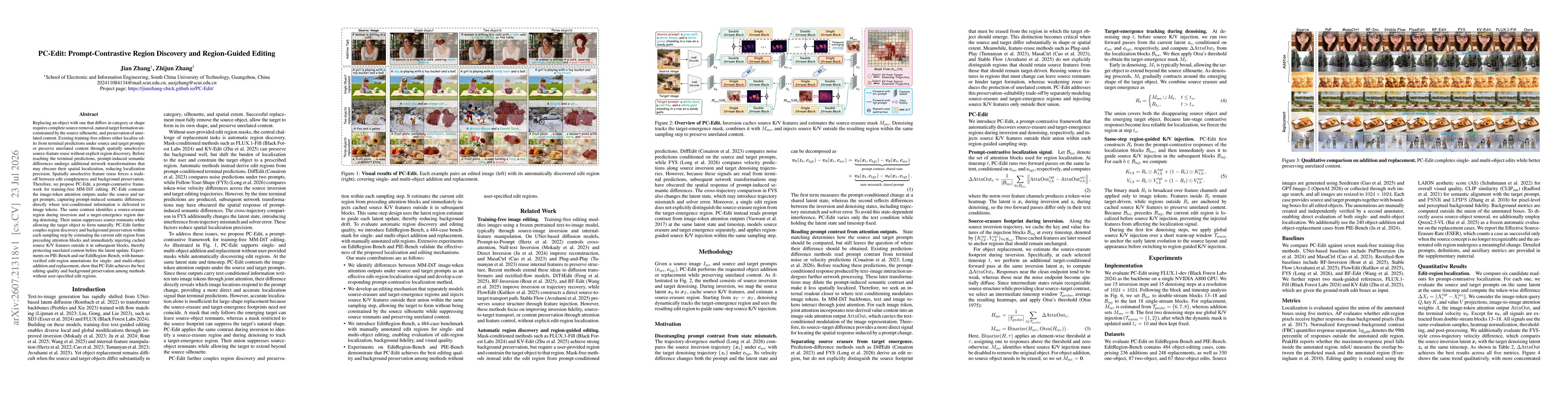
Replacing an object with one that differs in category or shape requires complete source removal, natural target formation unconstrained by the source silhouette, and preservation of unrelated content. Existing training-free editors either localize edits from terminal predictions under source and target prompts or preserve unrelated content through spatially unselective source-feature reuse without explicit region discovery. Before reaching the terminal predictions, prompt-induced semantic differences undergo additional network transformations that may obscure their spatial localization, reducing localization precision. Spatially unselective feature reuse forces a trade-off between edit completeness and background preservation. Therefore, we propose PC-Edit, a prompt-contrastive framework for training-free MM-DiT editing. PC-Edit contrasts the image-token attention outputs under the source and target prompts, capturing prompt-induced semantic differences directly where text-conditioned information is delivered to image tokens. The same contrast identifies a source-erasure region during inversion and a target-emergence region during denoising. Their union suppresses source remnants while allowing the target object to form naturally. PC-Edit further couples region discovery and background preservation within each sampling step by estimating the current edit region from preceding attention blocks and immediately injecting cached source K/V features outside it in subsequent blocks, thereby protecting unrelated content before the latent update. Experiments on PIE-Bench and our EditRegion-Bench, with human-verified edit-region annotations for single- and multi-object addition and replacement, show that PC-Edit achieves the best editing quality and background preservation among methods without user-specified edit regions.
Analysis
AI-generated · verify against the original paper
Generated Jul 25, 2026ResultsWhat the authors found
- PC-Edit achieves the best editing quality and background preservation among methods without user-specified edit regions on PIE-Bench and EditRegion-Bench.
- Joint region discovery and latent updates reduce background drift and preserve unrelated content during single- and multi-object edits.
- Automatic contrast-based localization provides more accurate spatial localization than relying on terminal predictions alone.
- The region-union mechanism avoids residual source remnants while allowing the target to form beyond the source silhouette.
LimitationsWhere the findings need caution
- Evaluation is limited to PIE-Bench and EditRegion-Bench; real-world diversity across domains remains to be tested.
- The method relies on the quality of attention-based localization, which may be challenged by highly ambiguous prompts or subtle semantic shifts.
- Computational overhead from maintaining and injecting K/V features across sampling steps may affect efficiency for large-scale edits.
MethodologyHow the work was done
PC-Edit introduces a prompt-contrastive framework for training-free MM-DiT editing by contrasting image-token attention under source versus target prompts to localize edit regions directly where text-conditioned information is delivered to image tokens. It identifies a source-erasure region during inversion and a target-emergence region during denoising, unions them to suppress source remnants while enabling the target, and couples region discovery with background preservation by estimating the edit region from preceding attention blocks and injecting cached source K/V features outside it in subsequent blocks. An EditRegion-Bench with manual annotations evaluates localization, background fidelity, and visual quality, and experiments on PIE-Bench and EditRegion-Bench demonstrate superior editing quality without user-specified regions.
SignificanceWhy the work matters
The approach enables accurate, training-free region-guided editing in MM-DiT models by directly leveraging prompt-conditioned token attention differences, improving localization precision and content preservation without requiring manual edit-region masks.
Technical contributionsWhat the work introduces
A training-free prompt-contrastive editing framework for MM-DiT that localizes edits via contrastive analysis of image-token attention under source/target prompts, identifies source-erasure and target-emergence regions, and fuses region discovery with background preservation through cross-block K/V feature injections.
NoveltyHow it differs from prior work
First to explicitly contrast prompt-conditioned image-token attention for automatic edit-region discovery in MM-DiT editing, coupling region localization with background preservation in a unified sampling step to enable accurate single- and multi-object edits without user-provided masks.
Future workQuestions that remain
- Extend to more complex multi-object edits with dynamic interactions and occlusions.
- Explore adaptive weighting between source-erasure and target-emergence regions to handle conflicting cues.
- Reduce compute by optimizing region estimation and feature injection pipelines without compromising localization accuracy.
Discussion 0