This paper explores the phase behavior implications of violating Newton's third law in nonequilibrium systems using computer simulations. It reveals that breaking interaction reciprocity in a binary mixture leads to a variety of non-equilibrium phases, including compositionally asymmetric phases and three-phase coexistence, offering insights into the structures in living systems and potential synthetic materials design.
Abstract
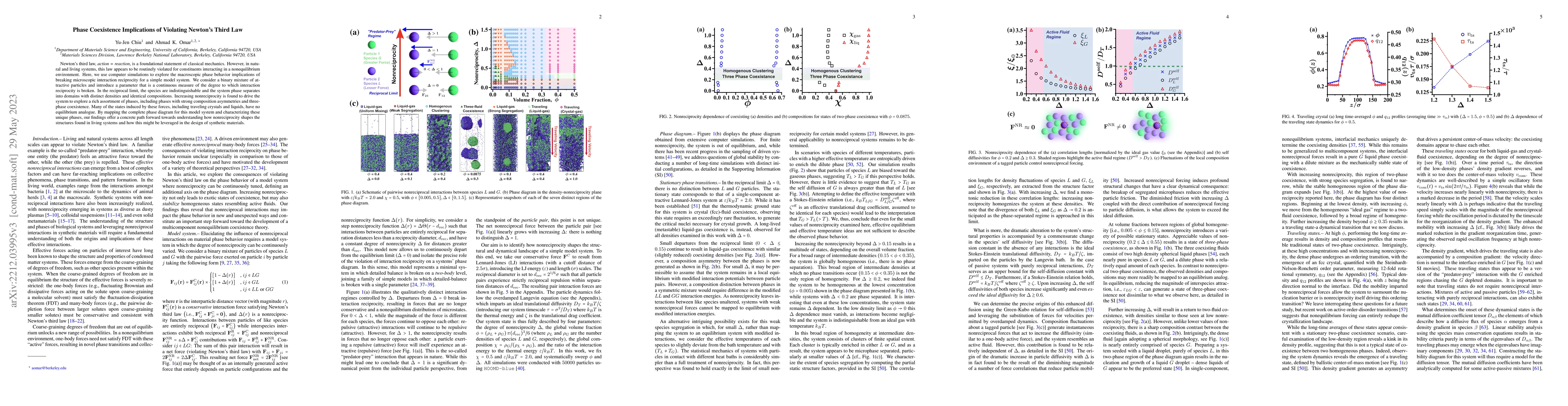
Newton's third law, actio = reactio, is a foundational statement of classical mechanics. However, in natural and living systems, this law appears to be routinely violated for constituents interacting in a nonequilibrium environment. Here, we use computer simulations to explore the macroscopic phase behavior implications of breaking microscopic interaction reciprocity for a simple model system. We consider a binary mixture of attractive particles and introduce a parameter which is a continuous measure of the degree to which interaction reciprocity is broken. In the reciprocal limit, the species are indistinguishable and the system phase separates into domains with distinct densities and identical compositions. Increasing nonreciprocity is found to drive the system to explore a rich assortment of phases, including phases with strong composition asymmetries and three-phase coexistence. Many of the states induced by these forces, including traveling crystals and liquids, have no equilibrium analogue. By mapping the complete phase diagram for this model system and characterizing these unique phases, our findings offer a concrete path forward towards understanding how nonreciprocity shapes the structures found in living systems and how this might be leveraged in the design of synthetic materials.
AI Key Findings
Get AI-generated insights about this paper's methodology, results, significance, and more — available when analysis has been generated.
Discussion 0