Phono3GPU: GPU-Accelerated Linear Tetrahedron Integration for Phonon Thermal Transport
Abstract
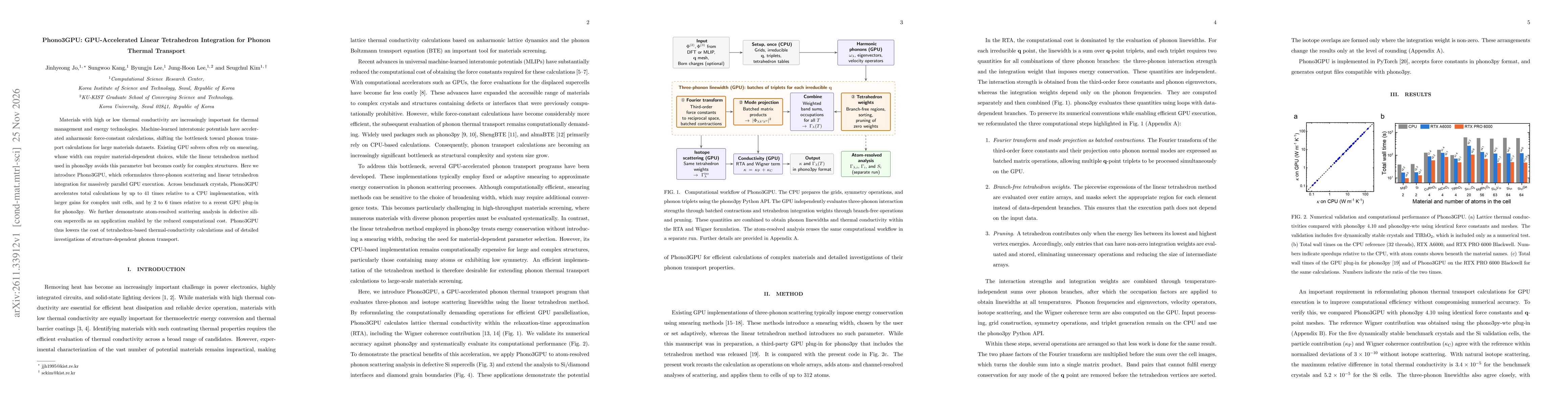
Materials with high or low thermal conductivity are increasingly important for thermal management and energy technologies. Machine-learned interatomic potentials have accelerated anharmonic force-constant calculations, shifting the bottleneck toward phonon transport calculations for large materials datasets. Existing GPU solvers often rely on smearing, whose width can require material-dependent choices, while the linear tetrahedron method used in phono3py avoids this parameter but becomes costly for complex structures. Here we introduce Phono3GPU, which reformulates three-phonon scattering and linear tetrahedron integration for massively parallel GPU execution. Across benchmark crystals, Phono3GPU accelerates total calculations by up to 41 times relative to a CPU implementation, with larger gains for complex unit cells, and by 2 to 6 times relative to a recent GPU plug-in for phono3py. We further demonstrate atom-resolved scattering analysis in defective silicon supercells as an application enabled by the reduced computational cost. Phono3GPU thus lowers the cost of tetrahedron-based thermal-conductivity calculations and of detailed investigations of structure-dependent phonon transport.
Analysis
AI-generated · verify against the original paper
Generated Jan 1, 0001ResultsWhat the authors found
- Achieves up to 41× speedup over a CPU implementation across benchmark crystals.
- Delivers 2–6× speedup relative to a recent GPU plug‑in for phono3py.
- Enables atom‑resolved phonon scattering analysis in defective silicon supercells.
MethodologyHow the work was done
Phono3GPU reformulates three-phonon scattering and linear tetrahedron integration to run on massively parallel GPUs, calculating lattice thermal conductivity within the relaxation-time approximation including Wigner coherence contributions.
SignificanceWhy the work matters
Phono3GPU dramatically reduces the computational cost of tetrahedron‑based thermal‑conductivity calculations, removing the need for smearing parameters and facilitating high‑throughput and detailed investigations of structure‑dependent phonon transport.
Technical contributionsWhat the work introduces
Introduces a GPU‑accelerated implementation of the linear tetrahedron method for three‑phonon and isotope scattering, optimized for massive parallel execution and validated against phono3py.
NoveltyHow it differs from prior work
First GPU‑based solver that combines the parameter‑free linear tetrahedron integration with efficient parallelization, avoiding the material‑dependent smearing required by existing GPU phonon transport codes.
Discussion 0