Physically Adversarial Infrared Patches with Learnable Shapes and Locations
This paper proposes a physically feasible infrared attack method called "adversarial infrared patches" that uses thermal insulation materials to manipulate thermal distribution and deceive infrared detectors. The method employs a novel aggregation regularization to learn the patch's shape and location, achieving over 90% Attack Success Rate in various detection tasks in real-world scenarios.
Abstract
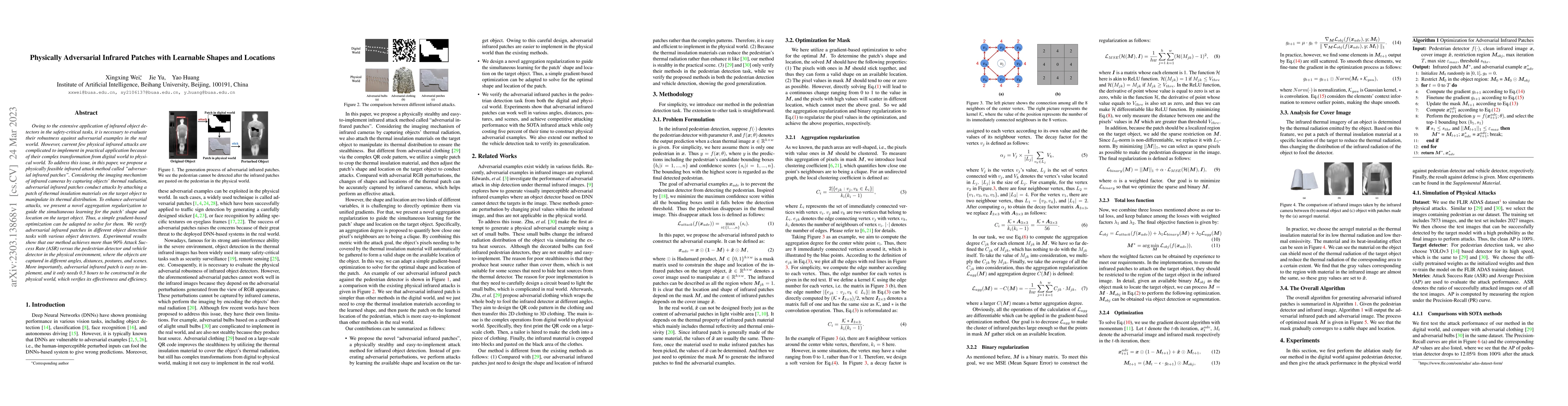
Owing to the extensive application of infrared object detectors in the safety-critical tasks, it is necessary to evaluate their robustness against adversarial examples in the real world. However, current few physical infrared attacks are complicated to implement in practical application because of their complex transformation from digital world to physical world. To address this issue, in this paper, we propose a physically feasible infrared attack method called "adversarial infrared patches". Considering the imaging mechanism of infrared cameras by capturing objects' thermal radiation, adversarial infrared patches conduct attacks by attaching a patch of thermal insulation materials on the target object to manipulate its thermal distribution. To enhance adversarial attacks, we present a novel aggregation regularization to guide the simultaneous learning for the patch' shape and location on the target object. Thus, a simple gradient-based optimization can be adapted to solve for them. We verify adversarial infrared patches in different object detection tasks with various object detectors. Experimental results show that our method achieves more than 90\% Attack Success Rate (ASR) versus the pedestrian detector and vehicle detector in the physical environment, where the objects are captured in different angles, distances, postures, and scenes. More importantly, adversarial infrared patch is easy to implement, and it only needs 0.5 hours to be constructed in the physical world, which verifies its effectiveness and efficiency.
AI Key Findings
Get AI-generated insights about this paper's methodology, results, significance, and more — available when analysis has been generated.
Discussion 0