PI-Mem: Pushing Long-Context Reasoning to 3.6M Tokens with Parallel-Iterative Memory
Abstract
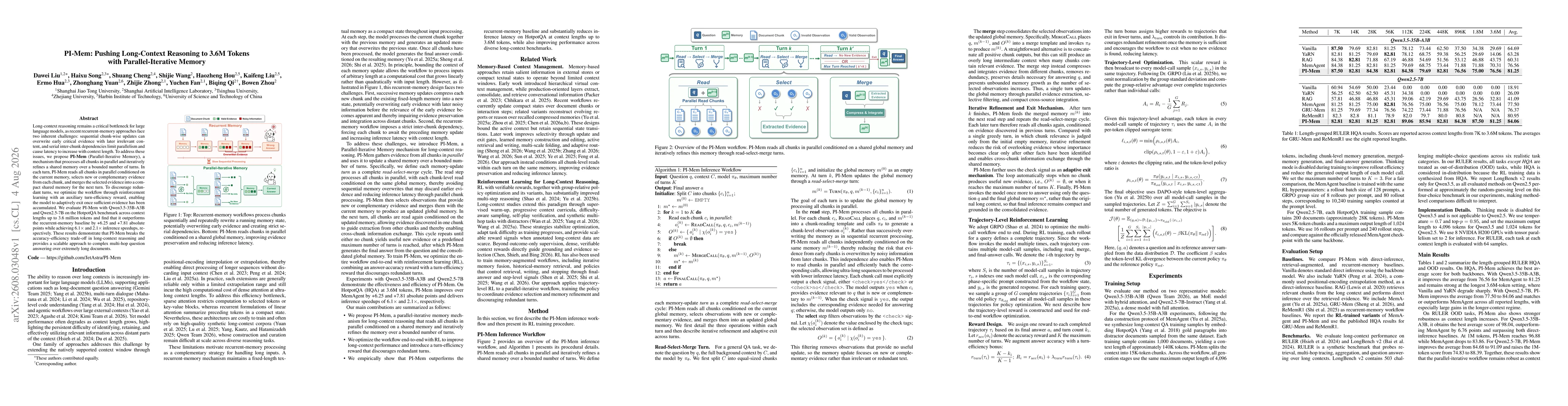
Long-context reasoning remains a critical bottleneck for large language models, as recent recurrent-memory approaches face two inherent challenges: sequential chunk-wise updates can overwrite early critical evidence with later irrelevant content, and serial inter-chunk dependencies limit parallelism and cause latency to increase with context length. To address these issues, we propose PI-Mem (Parallel-Iterative Memory), a mechanism that processes all chunks in parallel and iteratively refines a shared memory over a bounded number of turns. In each turn, PI-Mem reads all chunks in parallel conditioned on the current memory, selects new or complementary evidence from each chunk, and merges the selected evidence into a compact shared memory for the next turn. To discourage redundant turns, we optimize the workflow through reinforcement learning with an auxiliary turn-efficiency reward, enabling the model to adaptively exit once sufficient evidence has been accumulated. We evaluate PI-Mem with Qwen3.5-35B-A3B and Qwen2.5-7B on the HotpotQA benchmark across context lengths up to 3.6 million tokens and find that it outperforms the recurrent-memory baseline by +6.25 and +7.81 absolute points while achieving 6.1$\times$ and 2.1$\times$ inference speedups, respectively. These results demonstrate that PI-Mem breaks the accuracy--efficiency trade-off in long-context reasoning and provides a scalable approach to complex multi-hop question answering over extremely long documents.
Analysis
AI-generated · verify against the original paper
Generated Aug 6, 2026ResultsWhat the authors found
- On HotpotQA with context lengths up to 3.6M tokens, PI-Mem improves over a recurrent-memory baseline by 6.25 points (absolute) for one model and 7.81 points for another, indicating strong accuracy gains in long-context question answering.
- PI-Mem achieves inference speedups of 6.1x and 2.1x compared to the baseline across the evaluated models, demonstrating substantial efficiency benefits from parallel chunk processing and iterative memory refinement.
LimitationsWhere the findings need caution
- Results are primarily reported on HotpotQA; generalization to other long-context tasks or domains remains to be validated.
- The approach relies on reinforcement learning with a turn-efficiency reward, which may introduce training complexity and sensitivity to reward shaping or environment dynamics.
MethodologyHow the work was done
PI-Mem introduces a Parallel-Iterative Memory workflow that reads all document chunks in parallel conditioned on a shared global memory, then iteratively refines this memory over a bounded number of turns by selecting new or complementary evidence from each chunk and merging it into the memory. The process repeats until no new evidence is found or a maximum number of turns is reached, followed by final answer generation from the consolidated memory. Training uses trajectory-level reinforcement learning with an auxiliary turn-efficiency reward to discourage redundant turns and to enable adaptive exit once sufficient evidence is accumulated.
SignificanceWhy the work matters
The work demonstrates that long-context reasoning can surpass the traditional accuracy–efficiency trade-off by processing all chunks in parallel and iteratively refining a shared memory, enabling scalable multi-hop reasoning over extremely long documents with notable gains in both performance and speed.
Technical contributionsWhat the work introduces
A novel Parallel-Iterative Memory mechanism that (1) reads all chunks in parallel conditioned on a shared memory, (2) iteratively refines a compact global memory over a bounded number of turns via selective evidence merging, and (3) trains the entire workflow end-to-end with RL including a turn-efficiency reward to discourage redundant iterations.
NoveltyHow it differs from prior work
Distinct from prior recurrent-memory and sequentially updated approaches, PI-Mem eliminates inter-chunk dependencies by parallel processing and cross-chunk information exchange through iterative memory refinement, achieving scalable long-context reasoning with demonstrated accuracy and speed advantages.
Future workQuestions that remain
- Extend PI-Mem to a broader set of long-context benchmarks and real-world datasets to assess robustness across tasks.
- Investigate adaptive turn budgets and memory update strategies to further balance accuracy and latency under varying document lengths.
- Explore integration with more efficient memory representations or sparsity techniques to further scale to even longer contexts.
Discussion 0