Plan Big, Paint Small: Semantic-Aware Computation Allocation for Efficient Autoregressive Video Generation
Abstract
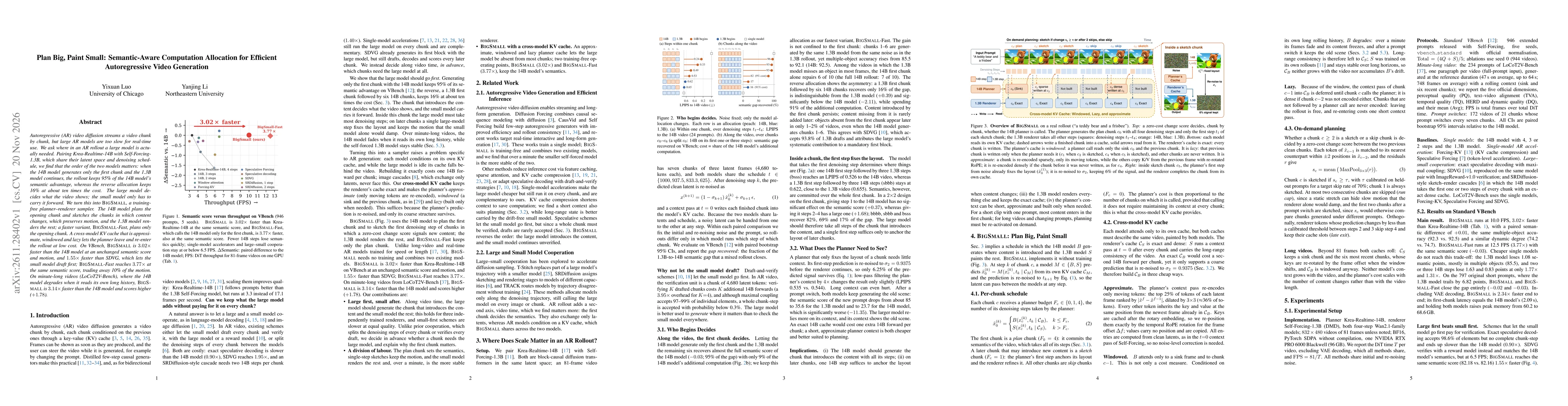
Autoregressive (AR) video diffusion streams a video chunk by chunk, but large AR models are too slow for real-time use. We ask where in an AR rollout a large model is actually needed. Pairing Krea-Realtime-14B with Self-Forcing-1.3B, which share their latent space and denoising schedule, we find that the order of the two models matters: when the 14B model generates only the first chunk and the 1.3B model continues, the rollout keeps 95\% of the 14B model's semantic advantage, whereas the reverse allocation keeps 16\% at about ten times the cost. The large model decides what the video shows; the small model only has to carry it forward. We turn this into BigSmall, a training-free planner--renderer sampler. The 14B model plans the opening chunk and sketches the chunks in which content changes, which preserves motion, and the 1.3B model renders the rest; a faster variant, BigSmall, plans only the opening chunk. A cross-model KV cache that is approximate, windowed and lazy lets the planner leave and re-enter the rollout at low cost. On VBench, BigSmall is $3.02\times$ faster than the 14B model at an unchanged semantic score and motion, and $1.55\times$ faster than SDVG, which lets the small model draft first; BigSmall reaches $3.77\times$ at the same semantic score, trading away 10\% of the motion. On minute-long videos (LoCoT2V-Bench), where the 14B model degrades when it reads its own long history, BigSmall is $3.14\times$ faster than the 14B model and scores higher ($+1.78$).`
AI Key Findings
Get AI-generated insights about this paper's methodology, results, significance, and more — available when analysis has been generated.
Discussion 0