Polar Streams through Active Condensation in Flocks
Abstract
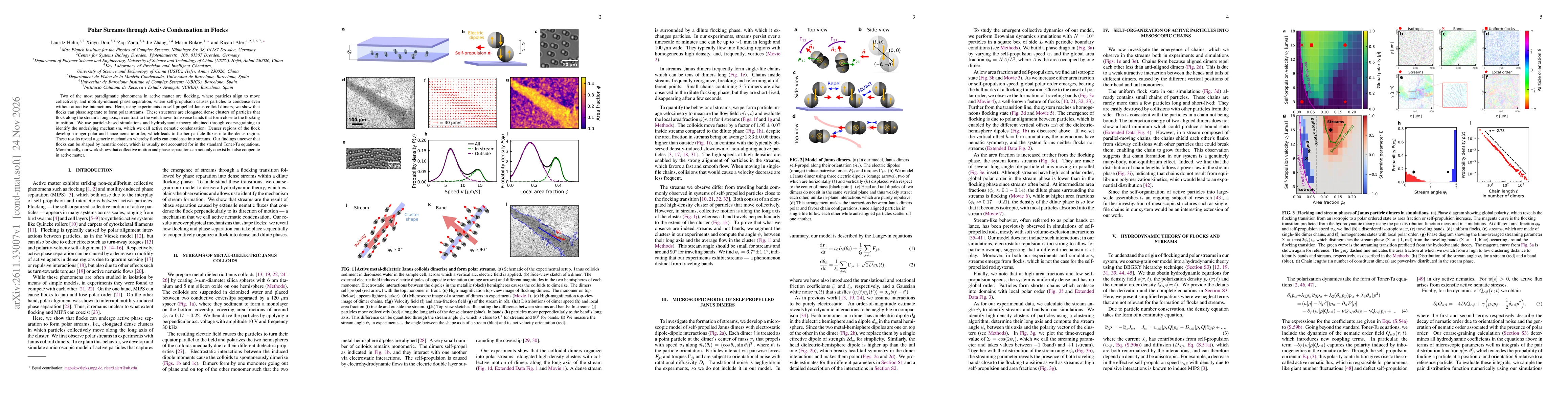
Two of the most paradigmatic phenomena in active matter are flocking, where particles align to move collectively, and motility-induced phase separation, where self-propulsion causes particles to condense even without attractive interactions. Here, using experiments on self-propelled Janus colloid dimers, we show that flocks can phase separate to form polar streams. These structures are elongated dense clusters of particles that flock along the stream's long axis, in contrast to the well-known transverse bands that form close to the flocking transition. We use particle-based simulations and hydrodynamic theory obtained through coarse-graining to identify the underlying mechanism, which we call active nematic condensation: Denser regions of the flock develop stronger polar and hence nematic order, which leads to further particle fluxes into the dense region. These results reveal a generic mechanism whereby flocks can condense into streams. Our findings uncover that flocks can be shaped by nematic order, which is usually not accounted for in the standard Toner-Tu equations. More broadly, our work shows that collective motion and phase separation can not only coexist but also cooperate in active matter.
AI Key Findings — Queued
Key findings generation is queued and will start shortly.
Discussion 0