Abstract
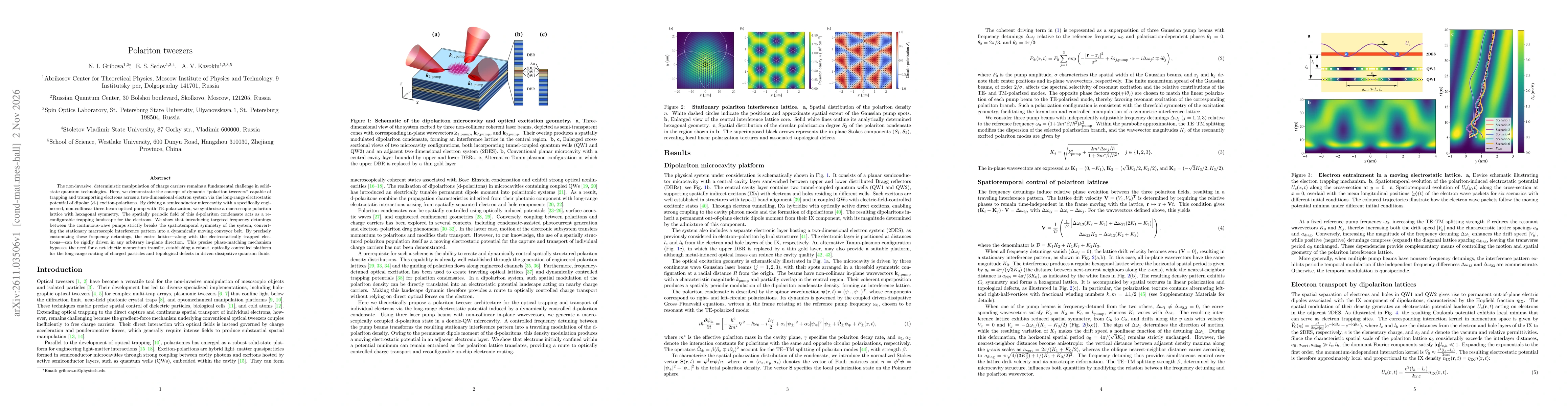
The non-invasive, deterministic manipulation of charge carriers remains a fundamental challenge in solid-state quantum technologies. Here, we demonstrate the concept of dynamic polariton tweezers capable of trapping and transporting electrons across a two-dimensional electron system via the long-range electrostatic potential of dipolar (d-) exciton-polaritons. By driving a semiconductor microcavity with a specifically engineered, non-collinear three-beam optical pump with TE-polarization, we synthesize a macroscopic polariton lattice with hexagonal symmetry. The spatially periodic field of this d-polariton condensate acts as a reconfigurable trapping landscape for the electrons. We show that introducing targeted frequency detunings between the continuous-wave pumps strictly breaks the spatiotemporal symmetry of the system, converting the stationary macroscopic interference pattern into a dynamically moving conveyor belt. By precisely customizing these frequency detunings, the entire lattice - along with the electrostatically trapped electrons - can be rigidly driven in any arbitrary in-plane direction. This precise phase-matching mechanism bypasses the need for a net kinetic momentum transfer, establishing a robust, optically controlled platform for the long-range routing of charged particles and topological defects in driven-dissipative quantum fluids.
Analysis
AI-generated · verify against the original paper
Generated Jan 1, 0001ResultsWhat the authors found
- The engineered polariton lattice forms a reconfigurable electrostatic trapping landscape for electrons in a nearby two‑dimensional electron system.
- Introducing frequency detunings causes the lattice to move as a rigid conveyor belt, carrying the trapped electrons without net kinetic momentum transfer.
- The direction and speed of electron transport can be arbitrarily controlled by customizing the detunings, enabling robust, optically‑controlled routing of charge carriers.
LimitationsWhere the findings need caution
- The study is theoretical and lacks experimental validation of the polariton‑tweezer operation.
- Precise control of multiple pump frequencies and phases is required, which may be challenging in practice.
MethodologyHow the work was done
A semiconductor microcavity with coupled quantum wells is driven by three non‑collinear continuous‑wave laser beams with TE polarization, creating a hexagonal lattice of dipolar exciton‑polaritons; targeted frequency detunings between the pumps break spatiotemporal symmetry and convert the stationary interference pattern into a moving lattice that transports trapped electrons via the long‑range electrostatic potential of the d‑polaritons.
SignificanceWhy the work matters
This work demonstrates a non‑invasive, deterministic method for long‑range manipulation of charge carriers in solid‑state platforms, opening new possibilities for optically‑controlled electronic routing and quantum fluid engineering.
Technical contributionsWhat the work introduces
Introduction of a dynamic polariton tweezer architecture that uses the electrostatic potential of a frequency‑detuned dipolar polariton condensate to trap and convey electrons across a two‑dimensional electron system.
NoveltyHow it differs from prior work
First proposal to employ a spatially structured, moving dipolar exciton‑polariton condensate as a reconfigurable, non‑contact trap for individual electrons, bypassing conventional optical gradient forces.
Future workQuestions that remain
- Experimental realization of dynamic polariton tweezers and measurement of electron transport.
- Integration of the technique with on‑chip electronic architectures and exploration of scalability.
- Investigation of transport of topological defects and many‑body excitations using the moving polariton lattice.
Discussion 0