PowerFix: Physics-Guided Iterative Repair for LLM-Assisted Power Converter Design
Abstract
Large language model (LLM) agents are increasingly being explored for automated engineering design. However, repairing power-converter designs that fail engineering validation remains challenging: the system must identify physical causes, locate responsible design variables, and resolve violations without compromising other constraints. We introduce PowerFix, a physics-guided iterative repair framework that converts validation failures into structured diagnoses and executable patches while preserving topology and design requirements. PowerDiagGraph links failed checks to possible physical causes and constrains repair routes. An LLM prioritizes these routes, while a deterministic compiler translates selected repairs into authorized field-level edits. Candidates are validated on isolated design copies and committed only after all required engineering checks pass; failed validation can guide replanning. On our constructed 96-task flyback repair benchmark, comprising injected single faults, coupled faults, and held-out natural failures from our design generator, PowerFix achieves 78.7% verified repair success rate (VRSR), compared with 30.1% for the strongest of three LLM baselines. Three additional replanning rounds increase VRSR to 88.4%. These offline results provide pilot-stage evidence within a simulation-based design workflow, with hardware prototype validation and transfer to a second converter topology as the next steps toward deployment.
Analysis
AI-generated · verify against the original paper
Generated Jan 1, 0001ResultsWhat the authors found
- PowerFix achieves a 78.7% verified repair success rate (VRSR) on a 96-task flyback repair benchmark, compared to 30.1% for the strongest LLM baseline.
- With three additional replanning rounds, VRSR increases to 88.4%.
- Ablation studies show each stage contributes to overall performance, and resource usage metrics are reported for various models.
LimitationsWhere the findings need caution
- Results are offline and based on simulation; hardware prototype validation is pending.
- The study does not assess stability under LLM provider updates or model snapshot variations.
- Cost analysis excludes graph authoring and deterministic enumeration overhead, limiting full cost assessment.
MethodologyHow the work was done
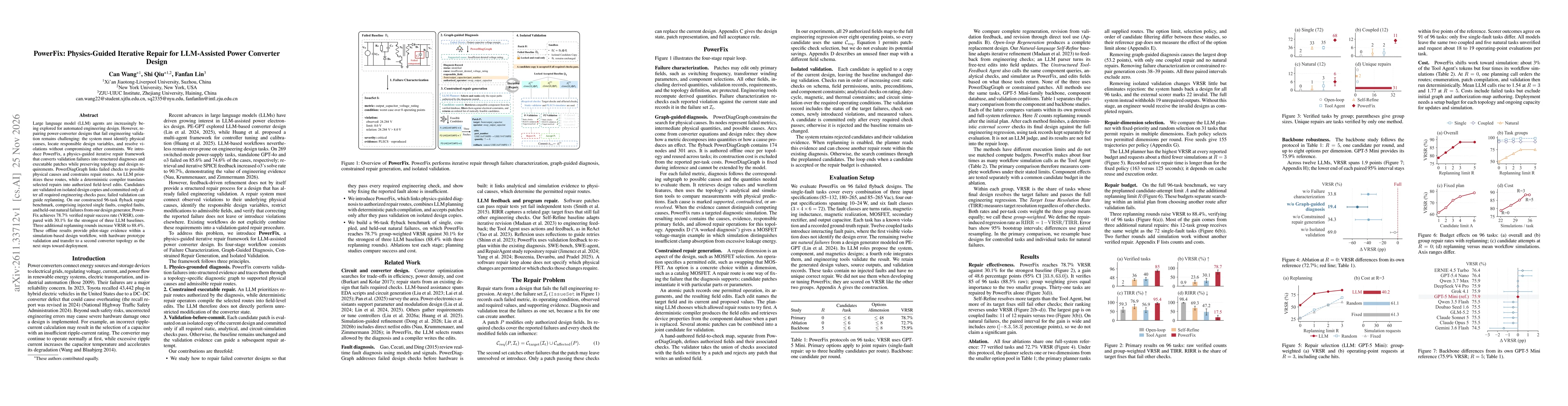
PowerFix follows a four-stage workflow: Failure Characterization, Graph-Guided Diagnosis using PowerDiagGraph to link failed checks to physical causes and authorized repair routes, Constrained Repair Generation where an LLM prioritizes routes and a deterministic compiler creates field-level edits, and Isolated Validation that tests candidate patches on design copies before committing.
SignificanceWhy the work matters
The framework demonstrates that physics‑guided diagnosis combined with LLM planning and deterministic compilation can substantially improve automated repair of power‑converter designs, addressing a critical gap in LLM‑assisted engineering workflows.
Technical contributionsWhat the work introduces
PowerFix introduces a physics‑guided diagnostic graph that constrains LLM‑generated repair routes and a deterministic compiler that translates selected routes into authorized field‑level edits, ensuring validation‑before‑commit in an iterative repair loop.
NoveltyHow it differs from prior work
The work uniquely combines physics‑based graph diagnosis with LLM planning and deterministic patch compilation to create a validation‑gated, iterative repair process for power‑converter design, a capability not present in prior LLM‑assisted engineering systems.
Future workQuestions that remain
- Validate PowerFix on physical hardware prototypes and transfer the approach to a second converter topology.
- Investigate model provenance and stability across provider updates and different model snapshots.
- Incorporate full cost accounting for graph construction and enumeration to evaluate deployment feasibility.
Discussion 0