This paper explores how diffusion anisotropy influences reaction coordinates in energy landscapes using the SGOOP method. It demonstrates that incorporating dynamical observables alongside static information enhances the accuracy of determining optimal reaction coordinates for various anisotropies, validated through comparisons with transmission coefficient calculations.
Abstract
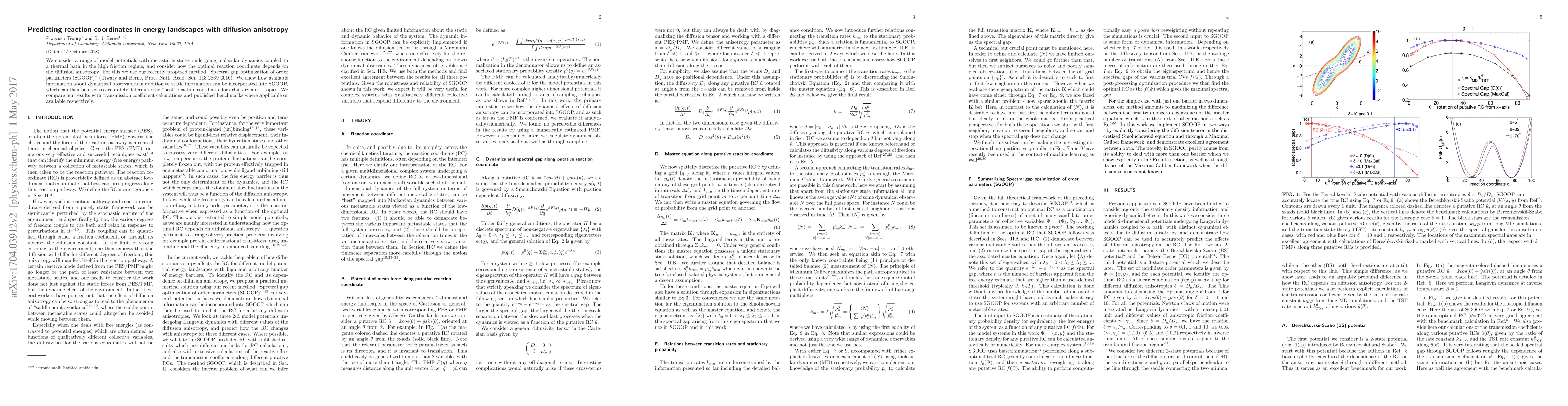
We consider a range of model potentials with metastable states undergoing molecular dynamics coupled to a thermal bath in the high friction regime, and consider how the optimal reaction coordinate depends on the diffusion anisotropy. For this we use our recently proposed method 'Spectral gap optimization of order parameters (SGOOP)' (Tiwary and Berne, Proc. Natl. Acad. Sci. 113 2839 2016). We show how available information about dynamical observables in addition to static information can be incorporated into SGOOP, which can then be used to accurately determine the 'best' reaction coordinate for arbitrary anisotropies. We compare our results with transmission coefficient calculations and published benchmarks where applicable or available respectively.
AI Key Findings
Get AI-generated insights about this paper's methodology, results, significance, and more — available when analysis has been generated.
Discussion 0