Pretraining Reusable Inference Across Views with Synthetic Task Priors
Abstract
Modern pretrained encoders make representations from heterogeneous views increasingly reusable, but the procedure that determines view utility and combines evidence is still relearned for each downstream task. Consequently, knowledge about view relevance, complementarity, reliability, and missingness is repeatedly discarded rather than transferred across tasks. We therefore reformulate multi-view learning as learning a reusable, task-conditioned inference procedure rather than a fixed fusion function. Based on this perspective, we propose SIMPLE, a prior-fitted multi-view in-context learner that predicts query labels by conditioning on a small labeled support set. Since existing real-world datasets cover only a limited range of view configurations and task structures, we construct a controllable synthetic task prior in embedding space. It generates diverse support-query episodes with varying class structures, shared and view-specific factors, representation geometries, cross-view dependencies, reliability levels, missingness patterns, and distribution shifts. A hierarchical inference architecture then performs reasoning within views, across views, and across support and query samples. Experiments on multi-view and multi-omics benchmarks demonstrate that the frozen variant of SIMPLE achieves competitive performance without updating the inference backbone, while lightweight adapter calibration attains leading performance on most evaluated datasets. Together, the results under frozen, one-shot, and missing-view settings support the central hypothesis that multi-view reasoning itself can be pretrained and reused, while lightweight adapter calibration provides task-specific alignment when needed.
Analysis
AI-generated · verify against the original paper
Generated Aug 21, 2026ResultsWhat the authors found
- SIMPLE-F achieves competitive accuracy without updating the inference backbone, illustrating effective frozen-contextual inference.
- SIMPLE-A with lightweight adapters attains leading performance on most evaluated datasets, outperforming several task-specific baselines.
- Across one-shot and missing-view settings, the model demonstrates transferability of multi-view inference as a reusable procedure, reducing need for repeated downstream adaptation.
- Coupled with the synthetic task prior, the hierarchical architecture effectively reasones within views, across views, and between support and query samples, yielding favorable accuracy–efficiency trade-offs.
LimitationsWhere the findings need caution
- Dependence on synthetic task priors: performance may rely on the realism and coverage of the synthetic task space.
- Evaluation primarily on benchmarks; real-world heterogeneity beyond reported datasets may affect transferability.
- One-shot and missing-view studies, while indicative, may not capture all edge cases in highly skewed or adversarial view configurations.
MethodologyHow the work was done
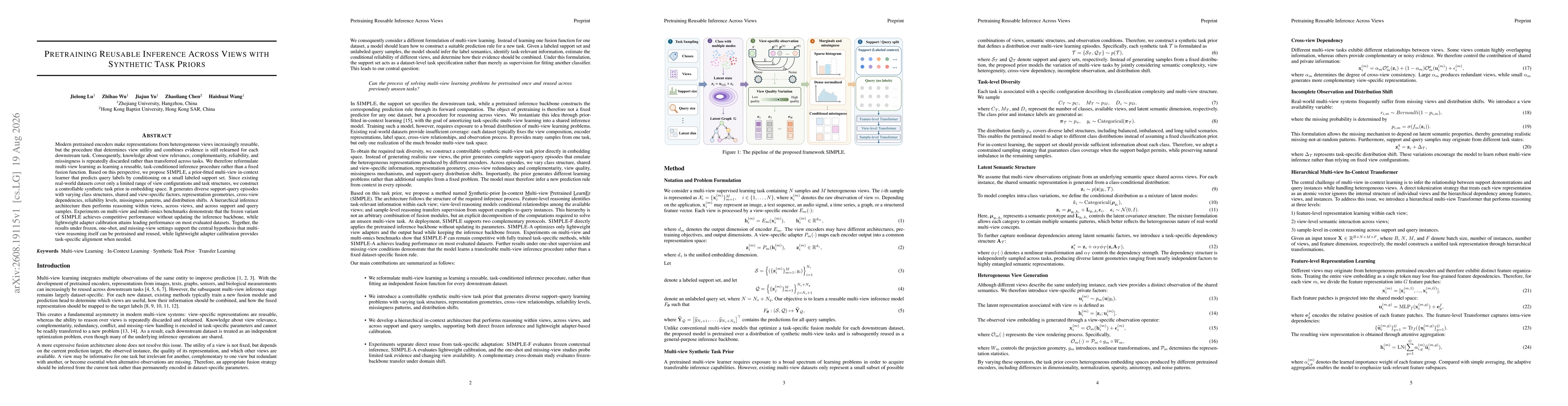
SIMPLE introduces a hierarchical in-context learning framework that pretrains a reusable inference procedure for multi-view data. It uses a controllable synthetic task prior to generate diverse support-query episodes and trains a backbone inference model to reason within views, across views, and across support-query samples. Deployment includes two protocols: SIMPLE-F (frozen backbone with no parameter updates) and SIMPLE-A (lightweight adapters and calibrated output head). Evaluation contrasts frozen inference, one-shot, missing-view conditions, and cross-domain transfer.
SignificanceWhy the work matters
Demonstrates that multi-view reasoning can be pretrained as a reusable inference procedure and transferred across tasks and domains, reducing downstream adaptation cost and enabling robust handling of missing views and distribution shifts.
Technical contributionsWhat the work introduces
Proposes a formalization of multi-view learning as reusable, task-conditioned inference; introduces a controllable synthetic task prior to train and evaluate a hierarchical in-context inference architecture (within-view, across-views, and support-query reasoning); demonstrates two deployment modes: frozen-backbone inference (SIMPLE-F) and adapters-based calibration (SIMPLE-A); provides systematic evaluation on multi-view and multi-omics benchmarks.
NoveltyHow it differs from prior work
First to pretrain a reusable multi-view inference procedure using synthetic task priors, enabling cross-task transfer of view reasoning without fixed fusion rules; combines hierarchical in-context reasoning with task-conditioned inference and demonstrates practical deployment variants with competitive performance.
Future workQuestions that remain
- Explore richer synthetic priors or real-data-augmented priors to broaden task coverage.
- Investigate automatic selection or adaptation of view adapters for unseen view types.
- Extend the framework to other modalities and larger view-sets with dynamic view reliability estimates.
Discussion 0