Probing cosmic velocity-density correlations with galaxy luminosity modulations
Abstract
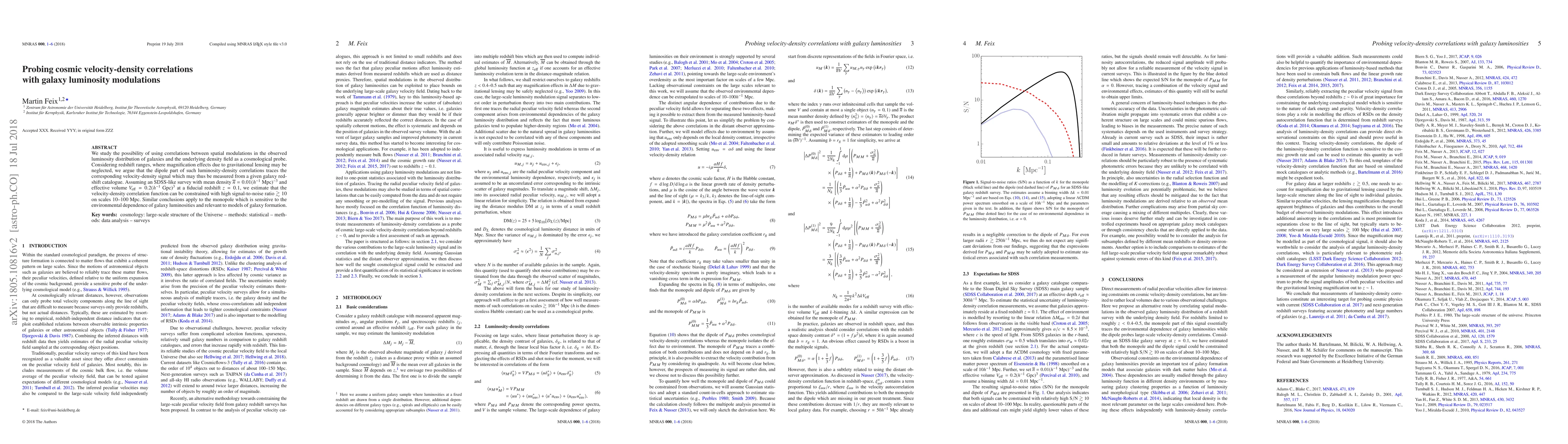
We study the possibility of using correlations between spatial modulations in the observed luminosity distribution of galaxies and the underlying density field as a cosmological probe. Considering redshift ranges, where magnification effects due to gravitational lensing may be neglected, we argue that the dipole part of such luminosity-density correlations traces the corresponding velocity-density signal which may thus be measured from a given galaxy redshift catalogue. Assuming an SDSS-like survey with mean density $\overline{n}$ = 0.01 ($h^{-1}$ Mpc)$^{-3}$ and effective volume $V_{\rm eff}$ = 0.2 ($h^{-1}$ Gpc)$^{3}$ at a fiducial redshift z = 0.1, we estimate that the velocity-density correlation function can be constrained with high signal-to-noise ratio $\gtrsim$ 10 on scales 10-100 Mpc. Similar conclusions apply to the monopole which is sensitive to the environmental dependence of galaxy luminosities and relevant to models of galaxy formation.
AI Key Findings
Get AI-generated insights about this paper's methodology, results, significance, and more — available when analysis has been generated.
Discussion 0