ProGeo-RC: Prototype-guided Semantic Reliability and Geometric Error Calibration for Semi-supervised Cardiac Image Segmentation
Abstract
Semi-supervised medical image segmentation aims to train reliable segmentation models using limited labeled data and abundant unlabeled data. However, existing methods typically rely on prediction confidence or model consistency to estimate pseudo-label reliability, but these criteria are insufficient to characterize both semantic reliability and geometric plausibility. To address this issue, we propose ProGeo-RC, a prototype-guided semantic reliability and geometric error calibration framework for semi-supervised medical image segmentation. ProGeo-RC consists of two key modules: Prototype-guided Semantic Reliability Estimation (PSRE) and Structured Semantic-Geometric Error Calibration (S-SGEC). PSRE uses probabilistic class prototypes to estimate the semantic reliability of unlabeled predictions and calibrate pixel-wise teacher pseudo labels, while S-SGEC introduces signed-distance-field-based geometric constraints to refine ambiguous boundaries and suppress spurious foreground responses outside target structures. Experiments on the ACDC and MVAA-CT datasets show that ProGeo-RC achieves better performance compared with representative semi-supervised segmentation methods. Under the 10\% labeled setting on ACDC, ProGeo-RC improves DSC and Jaccard by 0.37\% and 0.49\% over the corresponding second-best results, while reducing 95HD and ASD by 0.61 and 0.21, respectively. These results indicate that joint semantic reliability estimation and geometric error calibration can provide more reliable pseudo supervision for semi-supervised medical image segmentation.
Analysis
AI-generated · verify against the original paper
Generated Jan 1, 0001ResultsWhat the authors found
- On the ACDC dataset with only 10% labeled data, ProGeo-RC improves DSC by 0.37% and Jaccard index by 0.49% over the second-best method.
- The same setting shows reductions of 0.61 mm in 95% Hausdorff Distance and 0.21 mm in Average Surface Distance.
- Across both ACDC and MVAA-CT test splits, ProGeo-RC achieves the highest DSC, Jaccard, and lowest 95HD and ASD compared to representative semi-supervised segmentation methods.
MethodologyHow the work was done
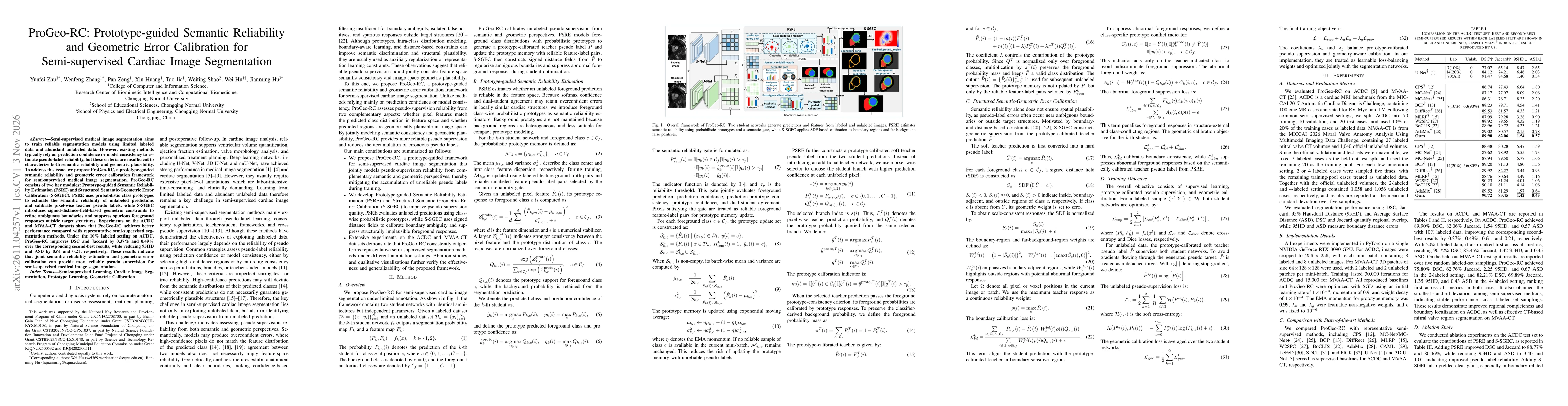
ProGeo-RC employs a dual-student network architecture with independent parameters. It introduces two modules: Prototype-guided Semantic Reliability Estimation (PSRE), which maintains class-wise probabilistic prototype memories to assess feature-space consistency of unlabeled predictions and calibrate teacher pseudo-labels; and Structured Semantic-Geometric Error Calibration (S-SGEC), which constructs signed-distance fields from calibrated pseudo-labels to enforce geometric plausibility, refine ambiguous boundaries, and suppress spurious foreground responses.
SignificanceWhy the work matters
By jointly modeling semantic reliability via probabilistic prototypes and geometric plausibility via signed-distance-field constraints, ProGeo-RC provides more trustworthy pseudo-supervision, enabling accurate cardiac image segmentation with substantially reduced annotation effort.
Technical contributionsWhat the work introduces
The paper introduces a prototype-guided semantic reliability estimator and a signed-distance-field based geometric error calibrator, integrating them into a semi-supervised learning framework that enhances pseudo-label quality without adding inference-time overhead.
NoveltyHow it differs from prior work
ProGeo-RC is the first semi-supervised cardiac segmentation approach that simultaneously leverages class prototype distributions for semantic reliability assessment and signed-distance-field constraints for geometric error correction.
Discussion 0