Proposal of quantum arrival-time measurement with a Bose-Einstein condensate
Abstract
This work shows how a Bose-Einstein condensate of ultracold atoms could be used to address a long-standing question in quantum theory: how much time does it take for a particle to reach a detector? To this end, we propose a realistic experimental setup, whose key idea is not to measure arrival times directly, but the arrival flux on the detector as a function of its position. This novel approach not only solves practical issues with having a detector close to the system, but also results in signals that allow to unambiguously distinguish different theoretical predictions. This proposal raises prospects for resolving the decades-old debate on this fundamental issue.
Analysis
AI-generated · verify against the original paper
Generated Jun 20, 2026ResultsWhat the authors found
- Different arrival-time predictions (density-like flux, probability flux, backward flux, and Kijowski flux) yield qualitatively similar distributions for a vertical arrangement, necessitating a practical, distance-based detection scheme to distinguish them.
- A horizontal detector arrangement can reveal distinctive oscillatory patterns in the averaged detector counts that depend on total atom number and trap frequencies, enabling discrimination of theories when averaged over many trials.
- Simulations show that averaging over a few hundred experiments would reveal the predicted oscillatory pattern, even with realistic fluctuations in atom number and trapping frequencies.
LimitationsWhere the findings need caution
- Predictions converge in many setups, requiring precise control of detector distance and environmental stability to observe distinguishing features.
- The approach relies on averaging many trials to overcome shot noise, which may be time-consuming and sensitive to experimental drifts.
MethodologyHow the work was done
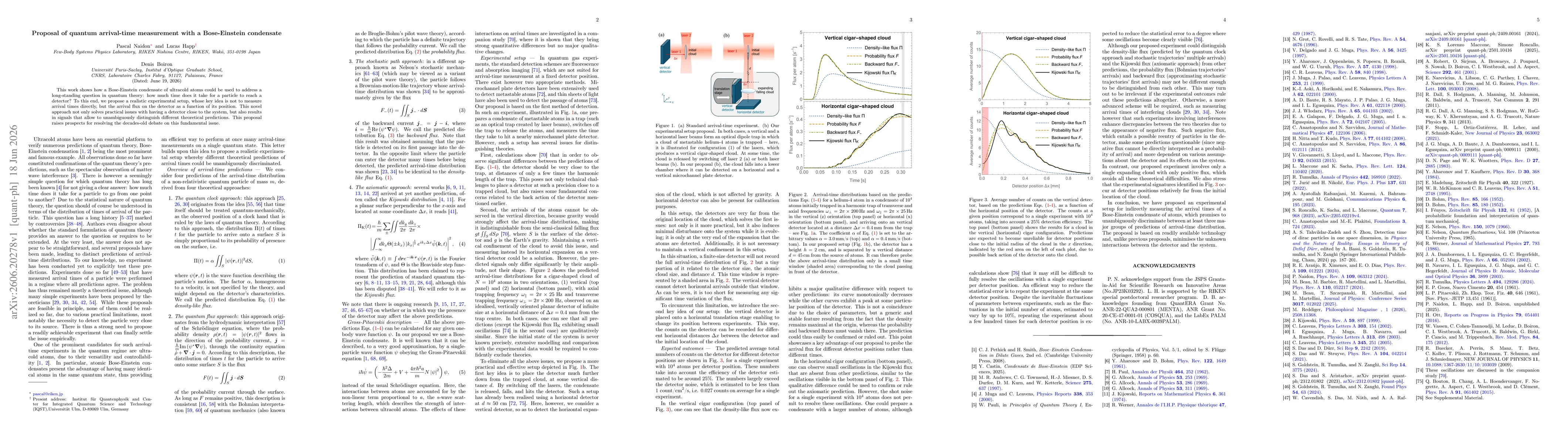
The paper proposes a realistic experimental setup using a metastable-atom Bose-Einstein condensate and a distant vertical microchannel plate detector to measure arrival flux as a function of detector position, rather than direct arrival times, to discriminate between theoretical arrival-time predictions.
SignificanceWhy the work matters
The work offers a feasible experimental route to address a long-standing quantum theory question about arrival times by converting time-of-arrival questions into spatially resolved flux measurements, with the potential to experimentally distinguish competing foundations of quantum mechanics.
Technical contributionsWhat the work introduces
A concrete, realizable experimental design combining a metastable atomic BEC with a distant microchannel plate detector to transform time-of-arrival questions into spatial flux measurements capable of distinguishing theoretical predictions.
NoveltyHow it differs from prior work
Introduces a practical setup that bypasses detector back-action and near-field constraints by measuring arrival flux at a distant detector, enabling empirical tests of four competing arrival-time theories in quantum mechanics.
Future workQuestions that remain
- Experimentally implement the proposed distant vertical detector and verify the predicted flux patterns across multiple parameter regimes.
- Investigate the impact of interactions in the Bose-Einstein condensate on arrival-time predictions beyond the single-particle Gross-Pitaevskii framework.
- Develop error mitigation and calibration strategies to reduce fluctuations in atom number and trap frequencies for clearer discrimination.
Discussion 0