Pseudo-Altermagnetism in Non-Hermitian Systems
Abstract
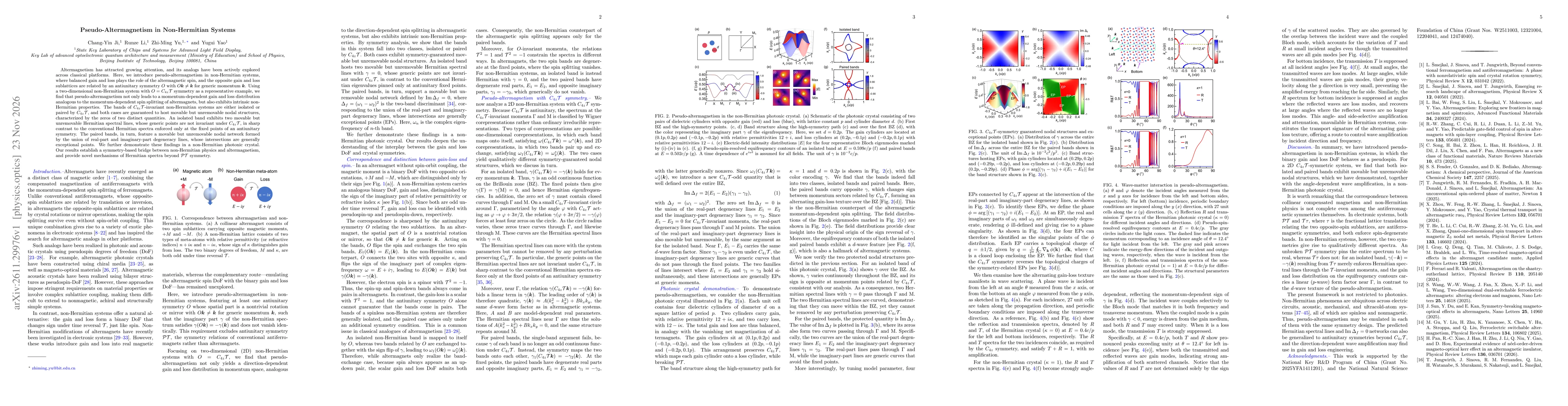
Altermagnetism has attracted growing attention, and its analogs have been actively explored across classical platforms. Here, we introduce pseudo-altermagnetism in non-Hermitian systems, where balanced gain and loss plays the role of the altermagnetic spin, and the opposite gain and loss sublattices are related by an antiunitary symmetry $O$ with $O\bm k\neq \bm k$ for generic momentum $\bm k$. Using a two-dimensional non-Hermitian system with $O=C_{4z}\mathcal{T}$ symmetry as a representative example, we find that pseudo-altermagnetism not only leads to a momentum-dependent gain and loss distribution analogous to the momentum-dependent spin splitting of altermagnets, but also exhibits intrinsic non-Hermitian properties. The bands of $C_{4z}\mathcal{T}$-invariant non-Hermitian systems are either isolated or paired by $C_{4z}\mathcal{T}$, and both cases are guaranteed to host movable but unremovable nodal structures, characterized by the zeros of two distinct quantities. An isolated band exhibits two movable but unremovable Hermitian spectral lines, whose generic points are not invariant under $C_{4z}\mathcal{T}$, in sharp contrast to the conventional Hermitian spectra enforced only at the fixed points of an antiunitary symmetry. The paired bands, in turn, feature a movable but unremovable nodal network formed by the union of real-part and imaginary-part degeneracy lines, whose intersections are generally exceptional points. We further demonstrate these findings in a non-Hermitian photonic crystal. Our results establish a symmetry-based bridge between non-Hermitian physics and altermagnetism, and provide novel mechanisms of Hermitian spectra beyond $\mathcal{PT}$ symmetry.
AI Key Findings
Get AI-generated insights about this paper's methodology, results, significance, and more — available when analysis has been generated.
Discussion 0