Pseudoscalar meson masses in magnetic fields at zero temperature from lattice QCD
Abstract
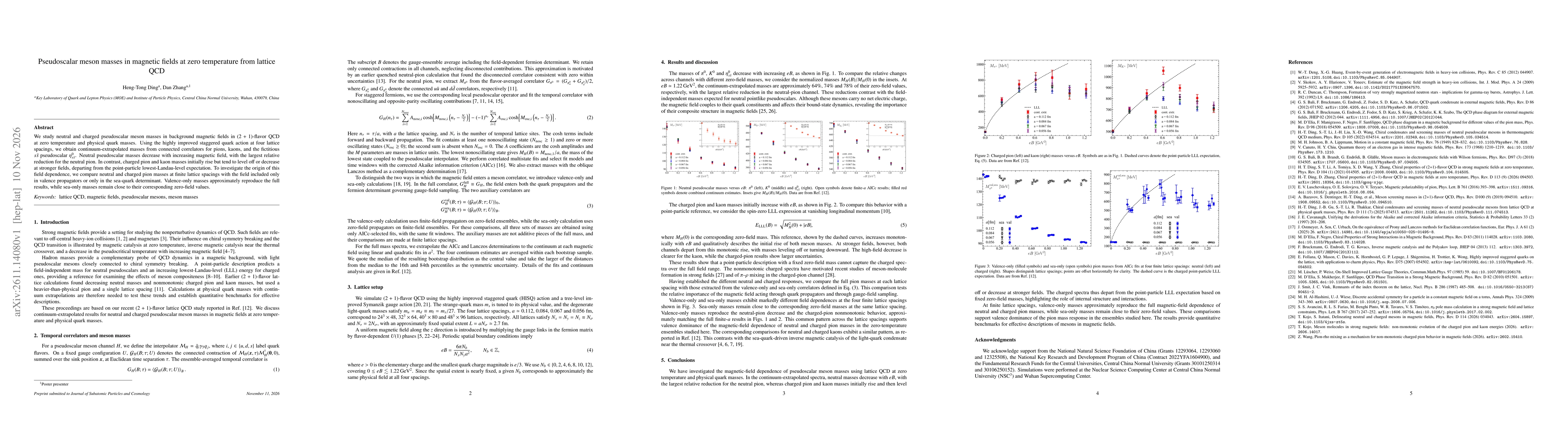
We study neutral and charged pseudoscalar meson masses in background magnetic fields in $(2+1)$-flavor QCD at zero temperature and physical quark masses. Using the highly improved staggered quark action at four lattice spacings, we obtain continuum-extrapolated masses from connected correlators for pions, kaons, and the fictitious $s\bar s$ pseudoscalar $η^0_{s\bar s}$. Neutral pseudoscalar masses decrease with increasing magnetic field, with the largest relative reduction for the neutral pion. In contrast, charged pion and kaon masses initially rise but tend to level off or decrease at stronger fields, departing from the point-particle lowest-Landau-level expectation. To investigate the origin of this field dependence, we compare neutral and charged pion masses at finite lattice spacings with the field included only in valence propagators or only in the sea-quark determinant. Valence-only masses approximately reproduce the full results, while sea-only masses remain close to their corresponding zero-field values.
Analysis
AI-generated · verify against the original paper
Generated Jan 1, 0001ResultsWhat the authors found
- Neutral pseudoscalar masses (π0, K0, η0s¯s) decrease with increasing magnetic field, with the neutral pion showing the largest relative reduction (to ~64% of its zero‑field value at eB≈1.22 GeV²).
- Charged pion and kaon masses initially rise with the magnetic field, following the lowest‑Landau‑level expectation, but then level off or decrease at stronger fields, deviating from the point‑particle prediction.
- Valence‑only calculations reproduce the full magnetic‑field dependence of both neutral and charged pion masses, whereas sea‑only masses remain close to their zero‑field values, indicating valence‑dominance of the field effect.
LimitationsWhere the findings need caution
- Only connected correlators were used, neglecting potentially relevant disconnected contributions.
- Auxiliary valence‑only and sea‑only studies were performed at finite lattice spacings without continuum extrapolation.
- Statistical uncertainties are larger for the charged‑pion mass at high magnetic fields.
MethodologyHow the work was done
We performed (2+1)-flavor lattice QCD simulations using the highly improved staggered quark (HISQ) action at four lattice spacings, extracted meson masses from connected temporal correlators, applied AICc-selected multi-state fits and oblique Lanczos cross‑checks, and extrapolated to the continuum; additionally we computed valence‑only and sea‑only correlators to isolate the magnetic‑field effects on quark propagators versus the fermion determinant.
SignificanceWhy the work matters
The results demonstrate that the internal quark structure of pseudoscalar mesons crucially influences their response to strong magnetic fields and provide quantitative benchmarks for effective models of mesons in magnetized QCD environments.
Technical contributionsWhat the work introduces
Provided the first continuum‑extrapolated pseudoscalar meson masses at physical quark masses in background magnetic fields, and introduced a systematic valence‑only versus sea‑only decomposition to pinpoint the origin of magnetic‑field effects.
NoveltyHow it differs from prior work
Achieves physical‑point, continuum results showing non‑monotonic behavior of charged meson masses and identifies valence‑dominance of magnetic‑field effects, which were not captured in earlier heavier‑pion or single‑spacing lattice studies.
Future workQuestions that remain
- Incorporate disconnected diagrams to assess their impact on neutral meson masses.
- Extend the study to finite temperature and to other hadronic channels.
- Increase statistical precision and perform continuum extrapolations for the valence‑only and sea‑only analyses.
Discussion 0