PSTO: A PDE-structured transport operator with shared implicit updates for multiscale CDR systems
Abstract
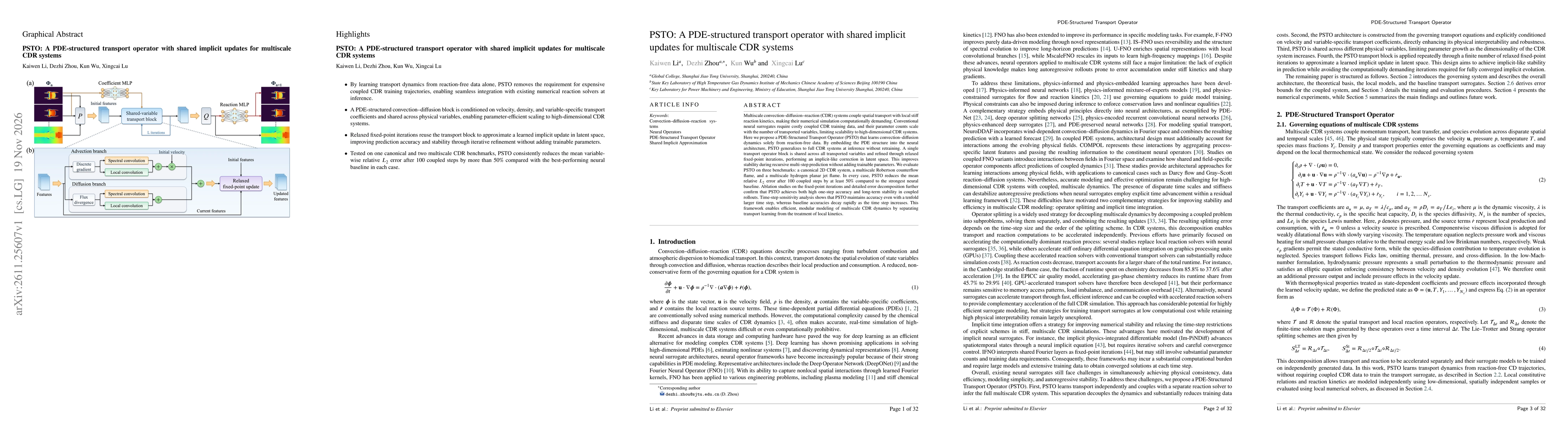
Multiscale convection-diffusion-reaction (CDR) systems couple spatial transport with local stiff reaction kinetics, making their numerical simulation computationally demanding. Conventional neural surrogates require costly coupled CDR training data, and their parameter counts scale with the number of transported variables, limiting scalability to high-dimensional CDR systems. Here we propose a PDE-Structured Transport Operator (PSTO) that learns convection--diffusion dynamics solely from reaction-free data. By embedding the PDE structure into the neural architecture, PSTO generalizes to full CDR systems at inference without retraining. A single transport operator block is shared across all transported variables and refined through relaxed fixed-point iterations, performing an implicit-like correction in latent space. This improves stability during recursive multi-step prediction without adding trainable parameters. We evaluate PSTO on three benchmarks: a canonical 2D CDR system, a multiscale Robertson counterflow flame, and a multiscale hydrogen planar jet flame. In every case, PSTO reduces the mean relative $L_2$ error after 100 coupled steps by at least 50% compared to the strongest neural baseline. Ablation studies on the fixed-point iterations and detailed error decomposition further confirm that PSTO achieves both high one-step accuracy and long-term stability in coupled rollouts. Time-step sensitivity analysis shows that PSTO maintains accuracy even with a tenfold larger time step, whereas baseline accuracies decay rapidly as the time step increases. This framework enables efficient, modular modeling of multiscale CDR dynamics by separating transport learning from the treatment of local kinetics.
Analysis
AI-generated · verify against the original paper
Generated Jan 1, 0001ResultsWhat the authors found
- PSTO reduces the mean variable-wise relative L2 error after 100 coupled steps by more than 50% compared to the best neural baseline on a canonical 2D CDR system, a Robertson counterflow flame, and a hydrogen planar jet flame.
- Time-step sensitivity analysis shows PSTO maintains accuracy with a tenfold larger time step, whereas baseline accuracies decay rapidly.
- Ablation studies confirm that the fixed-point iterations improve one-step accuracy and long-term stability without adding trainable parameters.
MethodologyHow the work was done
PSTO embeds PDE structure into a neural transport operator block conditioned on velocity, density, and variable-specific transport coefficients, which is shared across all transported variables and refined via relaxed fixed-point iterations that act as implicit updates in latent space.
SignificanceWhy the work matters
The framework enables efficient, modular modeling of multiscale convection‑diffusion‑reaction dynamics by learning transport from reaction‑free data, eliminating the need for expensive coupled training trajectories and allowing scalable surrogate modeling for high-dimensional CDR systems.
Technical contributionsWhat the work introduces
A shared, PDE‑structured transport operator with implicit-like latent updates that learns convection‑diffusion dynamics from reaction‑free data and generalizes to full CDR systems at inference without retraining.
NoveltyHow it differs from prior work
Introducing a transport operator block that is conditioned on physical coefficients, shared across variables, and refined through relaxed fixed-point iterations to achieve implicit updates, thereby decoupling transport learning from reaction kinetics.
Discussion 0