Pyramidal Person Re-IDentification via Multi-Loss Dynamic Training
Abstract
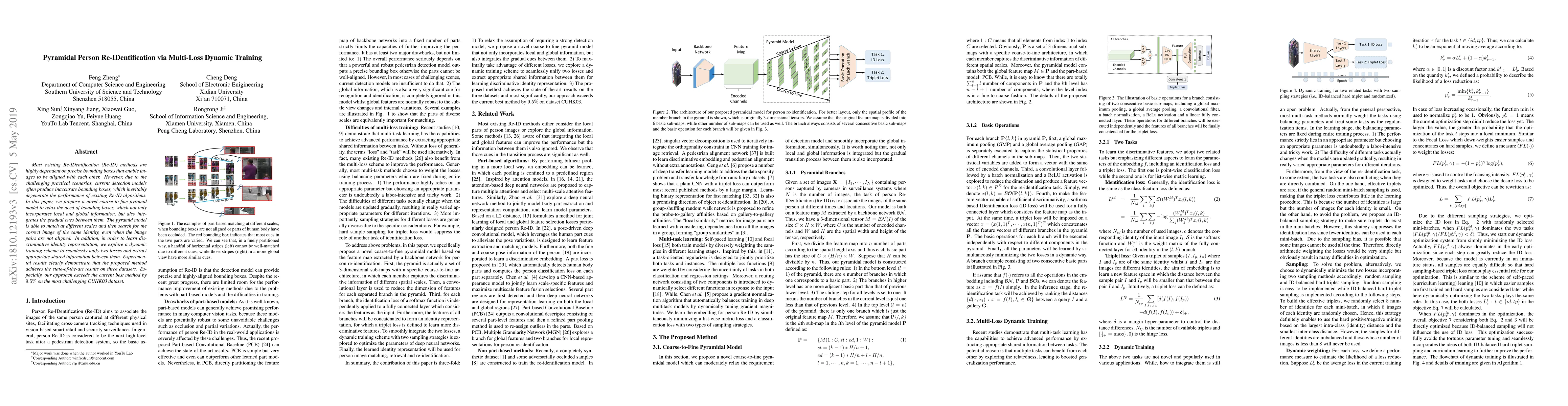
Most existing Re-IDentification (Re-ID) methods are highly dependent on precise bounding boxes that enable images to be aligned with each other. However, due to the challenging practical scenarios, current detection models often produce inaccurate bounding boxes, which inevitably degenerate the performance of existing Re-ID algorithms. In this paper, we propose a novel coarse-to-fine pyramid model to relax the need of bounding boxes, which not only incorporates local and global information, but also integrates the gradual cues between them. The pyramid model is able to match at different scales and then search for the correct image of the same identity, even when the image pairs are not aligned. In addition, in order to learn discriminative identity representation, we explore a dynamic training scheme to seamlessly unify two losses and extract appropriate shared information between them. Experimental results clearly demonstrate that the proposed method achieves the state-of-the-art results on three datasets. Especially, our approach exceeds the current best method by 9.5% on the most challenging CUHK03 dataset.
AI Key Findings
Get AI-generated insights about this paper's methodology, results, significance, and more — available when analysis has been generated.
Discussion 0