QFT-Based Hybrid PointNet-Quantum Neural Networks for LiDAR Point-Cloud Classification
Abstract
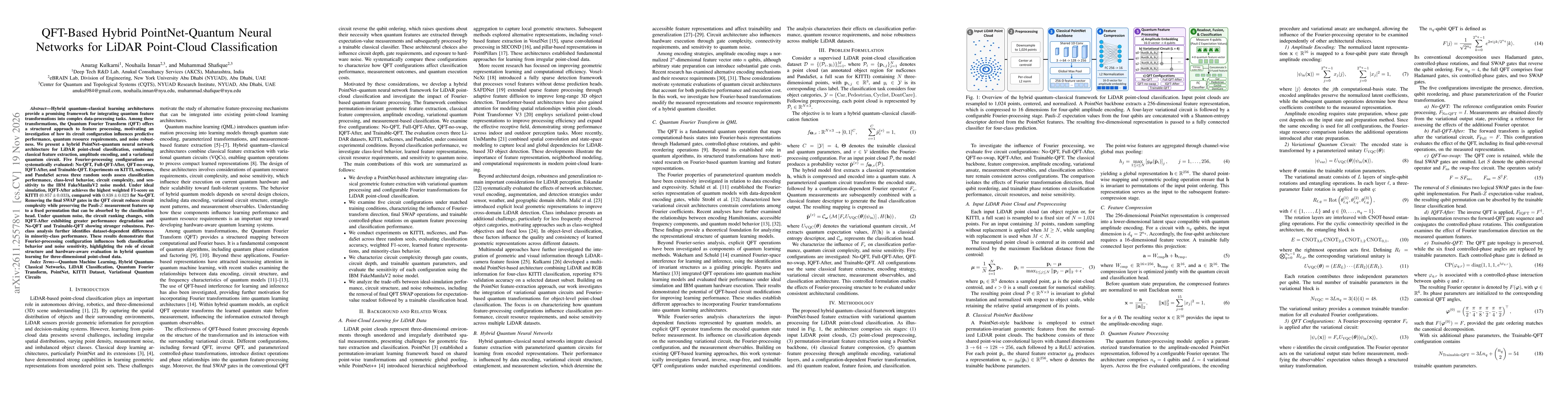
Hybrid quantum-classical learning architectures provide a promising framework for integrating quantum feature transformations into complex data-processing tasks. Among these transformations, the Quantum Fourier Transform (QFT) offers a structured approach to feature processing, motivating an investigation of how its circuit configuration influences predictive performance, quantum resource requirements, and noise robustness. We present a hybrid PointNet-quantum neural network architecture for LiDAR point-cloud classification, combining classical feature extraction, amplitude encoding, and a variational quantum circuit. Five Fourier-processing configurations are systematically evaluated: No-QFT, Full-QFT-After, QFT-no-swap, IQFT-After, and Trainable-QFT. Experiments on KITTI, nuScenes, and PandaSet across three random seeds assess classification performance, class-level behavior, circuit complexity, and sensitivity to the IBM FakeManilaV2 noise model. Under ideal simulation, IQFT-After achieves the highest weighted F1-score on KITTI (0.857 $\pm$ 0.033), compared with 0.838 $\pm$ 0.023 for No-QFT. Removing the final SWAP gates in the QFT circuit reduces circuit complexity while preserving the Pauli-Z measurement features up to a fixed permutation that can be absorbed by the classification head. Under quantum noise, the circuit ranking changes, with IQFT-After exhibiting greater performance degradation and No-QFT and Trainable-QFT showing stronger robustness. Per-class analysis further identifies dataset-dependent differences in minority-class performance. These results demonstrate that Fourier-processing configuration influences both classification behavior and noise sensitivity, highlighting the role of circuit structure and hardware-aware evaluation in hybrid quantum learning for three-dimensional point-cloud data.
Analysis
AI-generated · verify against the original paper
Generated Jan 1, 0001ResultsWhat the authors found
- Under ideal simulation IQFT‑After achieves the highest weighted F1 on KITTI (0.857 ± 0.033) compared to No‑QFT (0.838 ± 0.023).
- Removing the final SWAP gates (QFT‑no‑swap) reduces logical circuit complexity while preserving measurement features up to a permutation absorbed by the classifier.
- In hardware‑calibrated noise simulations, IQFT‑After shows the greatest performance degradation, whereas No‑QFT and Trainable‑QFT remain more robust.
- Dataset‑dependent trends are observed: Trainable‑QFT yields the best hardware‑calibrated F1 on KITTI, No‑QFT on nuScenes, and Trainable‑QFT on PandaSet.
- Logical gate‑count reductions do not always translate into lower compiled resource usage after transpilation.
LimitationsWhere the findings need caution
- Performance gains are dataset‑specific and do not generalize uniformly across all LiDAR benchmarks.
- Logical reductions (e.g., removing SWAPs) do not consistently lead to lower compiled resource requirements on actual backends.
- Evaluations are limited to simulated noise models and small‑scale four‑class classification tasks.
MethodologyHow the work was done
The authors design a hybrid architecture that combines a classical PointNet for geometric feature extraction with amplitude encoding of compressed features into a variational quantum circuit. Five configurable Quantum Fourier Transform (QFT) processing variants (No‑QFT, Full‑QFT‑After, QFT‑no‑swap, IQFT‑After, Trainable‑QFT) are inserted before measurement, and the resulting Pauli‑Z expectation values are fed to a trainable classification head. Experiments are conducted on KITTI, nuScenes and PandaSet using three random seeds, evaluating weighted F1‑score, per‑class behavior, gate counts, circuit depth and robustness to the IBM FakeManilaV2 noise model.
SignificanceWhy the work matters
The study demonstrates that the configuration of Fourier‑based quantum processing critically influences both predictive accuracy and noise resilience in hybrid quantum‑classical LiDAR point‑cloud classifiers, highlighting the need for hardware‑aware circuit design in emerging quantum machine‑learning applications.
Technical contributionsWhat the work introduces
Integration of configurable QFT modules into a hybrid PointNet‑quantum neural network, systematic benchmarking of five Fourier‑processing configurations across multiple LiDAR datasets, and analysis of their impact on classification performance, circuit complexity, and hardware noise robustness.
NoveltyHow it differs from prior work
First systematic evaluation of multiple Quantum Fourier Transform configurations within a hybrid quantum‑classical PointNet framework for LiDAR point‑cloud classification, revealing how circuit design choices affect both accuracy and noise tolerance.
Future workQuestions that remain
- Develop noise‑aware Fourier processing techniques that adapt to device error characteristics.
- Explore connectivity‑aware circuit optimizations to further reduce compiled depth and gate count.
- Investigate alternative quantum measurement strategies beyond Pauli‑Z expectation values.
- Validate the approach on physical quantum processors and extend experiments to larger, more diverse point‑cloud datasets.
Discussion 0