Quantification of Entanglement in Three-Qubit Systems
The paper analyzes how to quantify entanglement in pure three-qubit states using the Acín canonical form as a generalization of Schmidt decomposition. It introduces a global concurrence measure based on bipartitions, compares it with three-tangle and tripartite negativity across different entanglement classes, and shows it provides complementary insights into multipartite correlations and entanglement structure.
Abstract
This study presents an analytical investigation of entanglement quantification in three-qubit pure states through the Acín canonical representation, which serves as a generalization of the two-qubit Schmidt decomposition. Driven by the intricacies of multipartite entanglement and the shortcomings of current measures, we employ a global concurrence measure derived from the generalized concurrence of various bipartitions within the system. The characteristics of this measure are explored both analytically and numerically across a range of SLOCC entanglement classes, such as product, biseparable, GHZ-type, and W-type states. When compared to the three-tangle and tripartite negativity, our findings indicate that this measure yields complementary insights into multipartite correlations. The outcomes underscore the significance of this measure in elucidating the structure and distribution of entanglement within three-qubit quantum systems.
Analysis
AI-generated · verify against the original paper
Generated Jan 1, 0001ResultsWhat the authors found
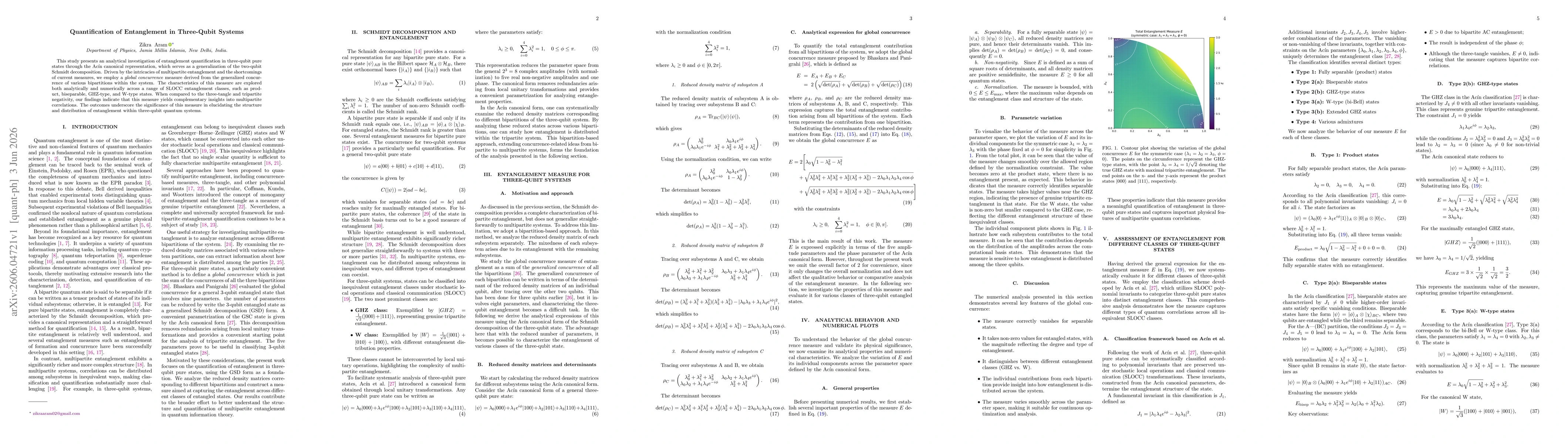
- A closed‑form expression for the global concurrence in terms of the five Acín parameters is derived for a general three‑qubit pure state.
- The global concurrence remains non‑zero for biseparable states, indicating sensitivity to bipartite entanglement, whereas the three‑tangle and tripartite negativity vanish when genuine tripartite entanglement is absent.
- Comparative analysis shows that the three measures provide complementary information for characterizing entanglement in three‑qubit pure states.
LimitationsWhere the findings need caution
- The analysis is restricted to pure three‑qubit states and does not address mixed‑state entanglement.
- The study does not extend the global concurrence measure to higher‑dimensional or larger multipartite systems.
MethodologyHow the work was done
The study analytically constructs a global concurrence measure from the one‑qubit‑versus‑rest bipartite concurrences of three‑qubit pure states, expresses it in closed form using the Acín canonical representation, and evaluates it on representative product, biseparable, GHZ‑type, and W‑type states while comparing it to the three‑tangle and tripartite negativity.
SignificanceWhy the work matters
The results provide an analytically tractable entanglement quantifier that captures bipartite contributions in multipartite systems and clarifies the distinct sensitivities of existing multipartite measures, aiding deeper understanding of entanglement structure in three‑qubit systems.
Technical contributionsWhat the work introduces
Derivation of a closed‑form global concurrence measure for three‑qubit pure states using the Acín canonical parameters and systematic comparison with three‑tangle and tripartite negativity.
NoveltyHow it differs from prior work
First analytical closed‑form expression of a global concurrence based on the Acín representation, providing a new tool to assess bipartite and multipartite entanglement simultaneously.
Future workQuestions that remain
- Extend the global concurrence framework to mixed states and investigate its behavior under decoherence.
- Generalize the approach to higher‑dimensional multipartite systems and explore dynamical scenarios.
Discussion 0