Quantitative Logarithmic Chowla Correlations Uniformly over Growing Shifts
The paper proves a near-optimal logarithmic bound for the two-point Liouville correlation λ(n)λ(n+h) weighted by 1/n, uniformly over shifts h up to a small power of log x. The authors introduce a scale-flexible, circle-method-based approach that preserves the fourth moment under dilation and leverages a flexible dyadic cutoff to cover all shifts, yielding an explicit exponent 1−cκ for any κ<1/700 and clarifying the range of shifts where the estimate holds without proving the full Cesàro Chowla conjecture.
Abstract
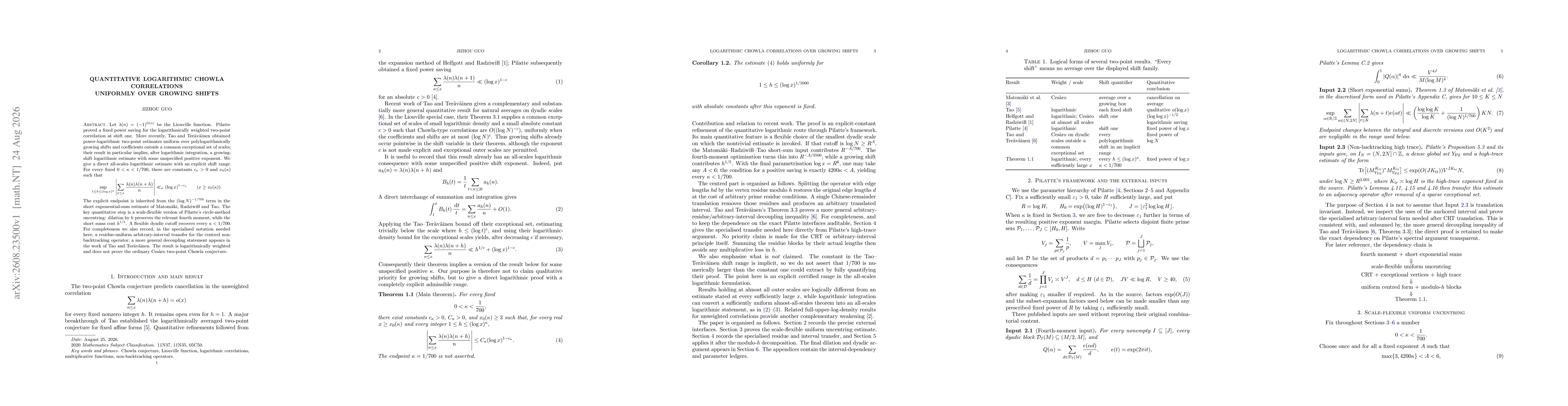
Let $λ(n)=(-1)^{Ω(n)}$ be the Liouville function. Pilatte proved a fixed power saving for the logarithmically weighted two-point correlation at shift one. More recently, Tao and Teräväinen obtained power-logarithmic two-point estimates uniform over polylogarithmically growing shifts and coefficients outside a common exceptional set of scales; their result in particular implies, after logarithmic integration, a growing-shift logarithmic estimate with some unspecified positive exponent. We give a direct all-scales logarithmic estimate with an explicit shift range. For every fixed $0<κ<1/700$, there are constants $c_κ>0$ and $x_0(κ)$ such that $\displaystyle \sup_{1\le h\le(\log x)^κ}\left|\sum_{n\le x}\frac{λ(n)λ(n+h)}{n}\right|\ll_κ(\log x)^{1-c_κ}\qquad (x\ge x_0(κ)).$ The explicit endpoint is inherited from the $(\log N)^{-1/700}$ term in the short exponential-sum estimate of Matomäki, Radziwiłł and Tao. The key quantitative step is a scale-flexible version of Pilatte's circle-method uncentring: dilation by $h$ preserves the relevant fourth moment, while the short sums cost $h^{1/5}$. A flexible dyadic cutoff recovers every $κ<1/700$. For completeness we also record, in the specialised notation needed here, a residue-uniform arbitrary-interval transfer for the centred non-backtracking operator; a more general decoupling statement appears in the work of Tao and Teräväinen. The result is logarithmically weighted and does not prove the ordinary Cesàro two-point Chowla conjecture.
Analysis
AI-generated · verify against the original paper
Generated Aug 26, 2026ResultsWhat the authors found
- For every fixed 0<κ<1/700, there exist constants cκ>0, Cκ>0, and x0(κ) such that for all x≥x0(κ) and 1≤h≤(log x)^{κ}, |sum_{n≤x} λ(n)λ(n+h)/n| ≪_κ (log x)^{1−cκ}.
- The endpoint κ=1/700 is explicit within the method due to the balance of dyadic scales and the fourth-moment optimization; the approach yields an all-scales logarithmic bound with a completely explicit admissible shift range.
- Dilation by h preserves the relevant fourth moment, enabling a scale-flexible uncentring that makes the short sums contribute at most h^{1/5}, which is crucial for the final exponent reduction.
- A flexible dyadic cutoff mechanism recovers every κ<1/700, ensuring uniform control across the growing shifts.
LimitationsWhere the findings need caution
- The result remains logarithmically weighted and does not prove the ordinary Cesàro two-point Chowla conjecture.
- The endpoint κ is explicitly bounded by 1/700, leaving room for improvement to larger growth ranges or to unconditional unweighted versions.
- The approach relies on delicate fourth-mmoment balances and dyadic decompositions which may be sensitive to generalizations beyond Liouville-type correlations.
MethodologyHow the work was done
The study develops a direct all-scales logarithmic estimate for Liouville two-point correlations with uniformly growing shifts by employing a scale-flexible version of Pilatte’s circle-method uncentring, analyzing dilation by h which preserves the relevant fourth moment while short sums cost h^{1/5}, and using a flexible dyadic cutoff to cover κ<1/700; it also includes a residue-uniform transfer principle for centred non-backtracking operators to ensure completeness.
SignificanceWhy the work matters
Provides an explicit, all-scales logarithmic bound for logarithmically weighted two-point Chowla correlations with growing shifts, advancing from prior results that had unspecified exponents and exceptional sets; the method clarifies the shift-range dependence and strengthens quantitative understanding of multiplicative correlations over growing shifts.
Technical contributionsWhat the work introduces
Introduces a scale-flexible uncentring of Pilatte’s circle method enabling dilation-invariant fourth-moment control, and a dyadic cutoffs framework that recovers all κ<1/700; also records a residue-uniform transfer for the centred non-backtracking operator within the problem’s specialised notation.
NoveltyHow it differs from prior work
Delivers an explicit all-scales logarithmic estimate for Liouville correlations with growing shifts, featuring an explicit shift-range endpoint and a direct, scalable circle-method modification not previously available in the literature.
Future workQuestions that remain
- Extend the method to enlarge the admissible κ range beyond 1/700, potentially approaching larger growth scales or even unbounded shifts under refined moment balances.
- Investigate unweighted or Cesàro-type two-point Chowla correlations with growing shifts using similar scale-flexible circle-method adaptations.
- Explore further the residue-uniform transfer and non-backtracking operator framework to other multiplicative-function correlations and their average forms.
Discussion 0