Quantum Optimization Algorithm for Pinching-Antenna Activation with Max-Min Fairness
Abstract
In this letter, we propose a training-free quantum approximate optimization algorithm with a linear-ramp schedule (LR-QAOA) for antenna activation in pinching-antenna systems (PASS). Since all active pinching antennas (PAs) share one feed and split its power, maximizing the signal-to-noise ratio (SNR) of the weakest user becomes a combinatorial max-min problem that must be re-solved whenever the users move. We formulate the problem as a two-local Ising Hamiltonian with one qubit per PA and no penalty terms, employing a weightedsum surrogate to prioritize weaker users. Instead of training the circuit with a classical optimizer, the proposed LR-QAOA method tunes its parameters via a linear ramp; the measured patterns are ranked by the exact max-min objective, and the best ones are refined with a short local search using the same number of evaluated patterns. Monte Carlo simulations show that the proposed LR-QAOA method outperforms greedy activation, projection-guided activation, and semidefinite relaxation-based classical baseline methods when all methods test the same number of PA on/off patterns. Experiments on real IBM Quantum hardware further show that the execution time remains nearly constant as the number of PAs grows, whereas exhaustive search grows exponentially. However, gate noise in the NISQ era restricts near-optimal hardware solutions to small numbers of antennas only.
Analysis
AI-generated · verify against the original paper
Generated Jan 1, 0001ResultsWhat the authors found
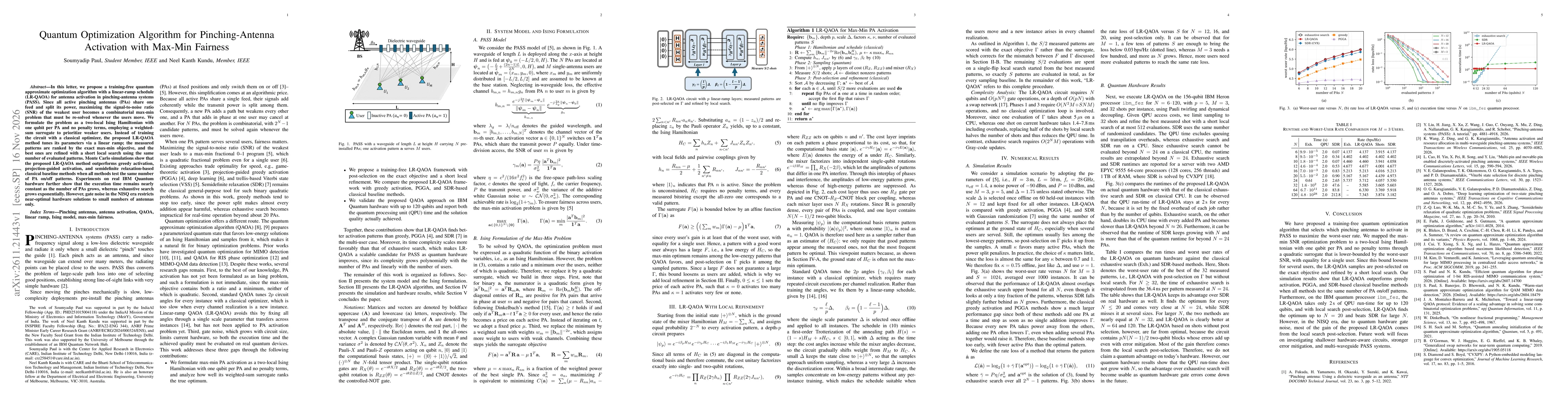
- LR‑QAOA achieves worst‑user rates that almost overlap the exhaustive‑search upper bound while using only a tiny fraction of the possible patterns, outperforming greedy, PGGA, and SDR baselines.
- On IBM quantum hardware the QPU runtime remains roughly constant (~2 s) as the number of pinching antennas grows up to 120 qubits, whereas exhaustive search time grows exponentially.
- With post‑selection and local refinement LR‑QAOA finds the optimal pattern up to N=20 and beats SDR for larger N, though most gain comes from the classical local search due to hardware noise.
LimitationsWhere the findings need caution
- Gate noise in NISQ devices limits near‑optimal quantum solutions to small numbers of antennas, requiring reliance on the classical local search.
- The quadratic surrogate used to encode the max‑min objective does not always place the true optimum at the ground state, leading to occasional mismatches.
- Current hardware errors in two‑qubit blocks degrade solution quality, preventing a clear quantum advantage on today’s devices.
MethodologyHow the work was done
The paper proposes a training‑free quantum approximate optimization algorithm (LR‑QAOA) that uses a linear‑ramp schedule to set all circuit angles via a single scale parameter, evaluates S/2 sampled activation patterns, ranks them with the exact max‑min SNR objective, and refines the best patterns with a short local flip search, all without classical optimizer loops.
SignificanceWhy the work matters
The approach demonstrates that quantum optimization can provide scalable, near‑optimal antenna activation with max‑min fairness, offering constant‑time pattern selection that is infeasible with classical exhaustive search for large antenna arrays.
Technical contributionsWhat the work introduces
Formulated the max‑min antenna activation problem as a two‑local Ising Hamiltonian with one qubit per antenna and no penalty terms, and introduced a training‑free LR‑QAOA framework with exact‑objective post‑selection and a short local refinement step.
NoveltyHow it differs from prior work
First work to apply a linear‑ramp, training‑free QAOA to the max‑min fairness antenna activation problem, providing a penalty‑free Ising encoding and a scalable quantum‑classical hybrid solution.
Future workQuestions that remain
- Investigate shallower, hardware‑aware circuit designs to reduce error accumulation.
- Develop stronger error‑mitigation techniques to improve solution quality on NISQ hardware.
- Extend the method to multi‑waveguide PASS systems and explore broader hardware implementations.
Discussion 0