This paper proposes a quantum simulation of the dynamical Casimir effect using trapped ions in a segmented ion trap, mapping cavity dynamics to radial phonons. The study validates the feasibility of this simulation under realistic experimental conditions, enabling single-photon level observation of photon production.
Abstract
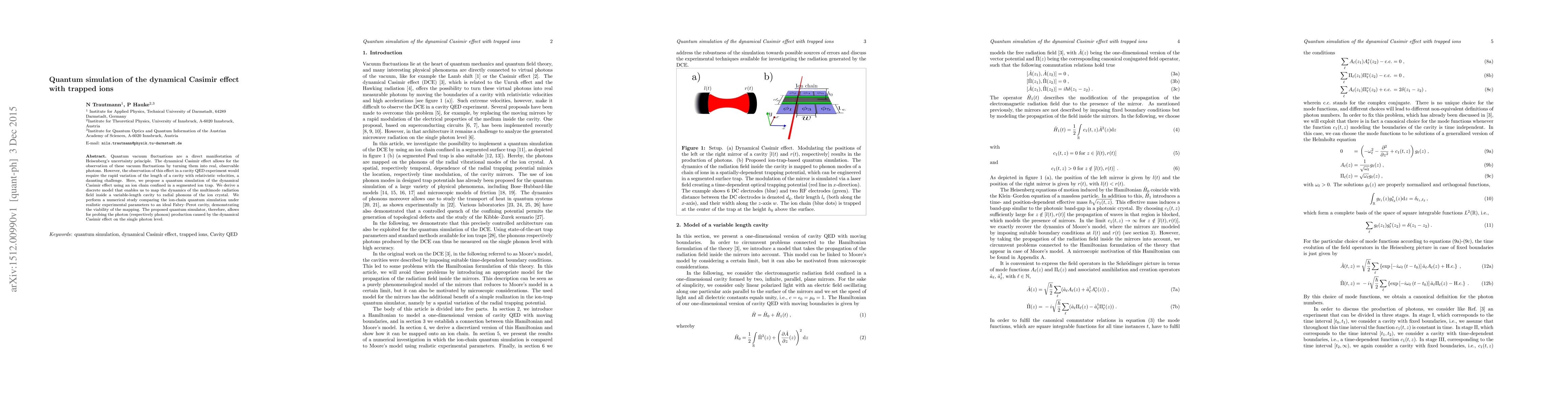
Quantum vacuum fluctuations are a direct manifestation of Heisenberg's uncertainty principle. The dynamical Casimir effect allows for the observation of these vacuum fluctuations by turning them into real, observable photons. However, the observation of this effect in a cavity QED experiment would require the rapid variation of the length of a cavity with relativistic velocities, a daunting challenge. Here, we propose a quantum simulation of the dynamical Casimir effect using an ion chain confined in a segmented ion trap. We derive a discrete model that enables us to map the dynamics of the multimode radiation field inside a variable-length cavity to radial phonons of the ion crystal. We perform a numerical study comparing the ion-chain quantum simulation under realistic experimental parameters to an ideal Fabry-Perot cavity, demonstrating the viability of the mapping. The proposed quantum simulator, therefore, allows for probing the photon (respectively phonon) production caused by the dynamical Casimir effect on the single photon level.
AI Key Findings
Get AI-generated insights about this paper's methodology, results, significance, and more — available when analysis has been generated.
Discussion 0