RadarOSV: Unified 3D Scene and Motion Perception from mmWave Radars
Abstract
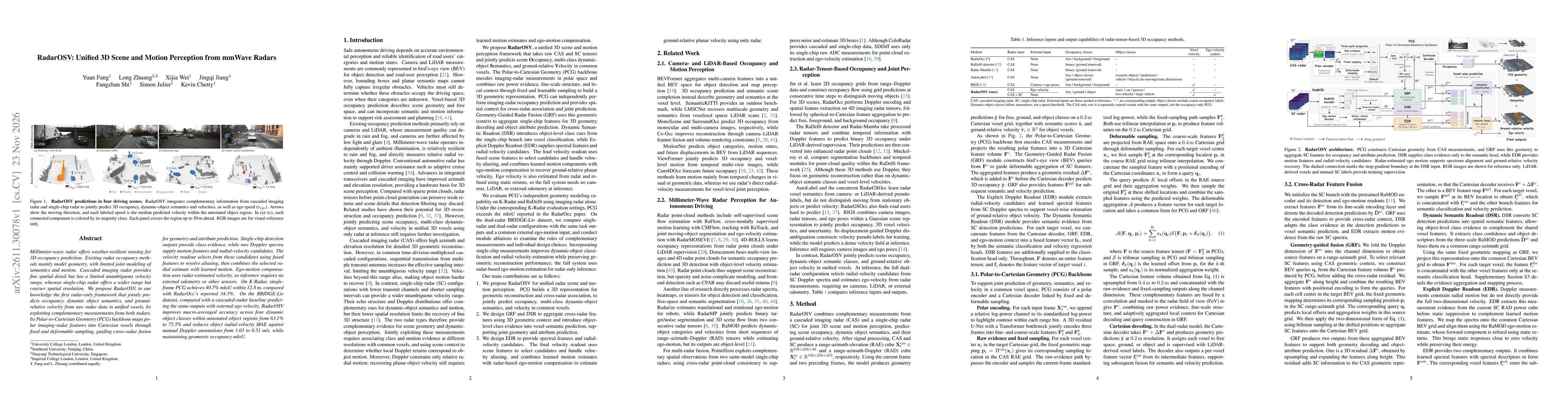
Millimeter-wave radar offers weather-resilient sensing for 3D occupancy prediction. Existing radar occupancy methods mainly model geometry, with limited joint modeling of semantics and motion. Cascaded imaging radar provides fine spatial detail but has a limited unambiguous velocity range, whereas single-chip radar offers a wider range but coarser spatial resolution. We propose RadarOSV, to our knowledge the first radar-only framework that jointly predicts occupancy, dynamic object semantics, and ground-relative velocity from raw radar data in unified voxels, by exploiting complementary measurements from both radars. Its Polar-to-Cartesian Geometry (PCG) backbone maps polar imaging-radar features into Cartesian voxels through fixed and deformable sampling, guiding cross-radar fusion for geometry and attribute prediction. Single-chip detection outputs provide class evidence, while raw Doppler spectra supply motion features and radial-velocity candidates. The velocity readout selects from these candidates using fused features to resolve aliasing, then combines the selected radial estimate with learned motion. Ego-motion compensation uses radar-estimated velocity, so inference requires no external odometry or other sensors. On K-Radar, single-frame PCG achieves 40.7% mIoU within 12.8 m, compared with RadarOcc's reported 34.3%. On the BRIDGE-Liv dataset, compared with a cascaded-radar baseline predicting the same outputs with external ego velocity, RadarOSV improves macro-averaged accuracy across four dynamic object classes within annotated object regions from 63.1% to 75.5% and reduces object radial-velocity MAE against manual Doppler annotations from 1.03 to 0.51 m/s, while maintaining geometric occupancy mIoU.
AI Key Findings
Get AI-generated insights about this paper's methodology, results, significance, and more — available when analysis has been generated.
Discussion 0