Radio Map Updating from Streaming Spectrum Measurements via Memory-Based Online Gaussian Processes
The paper introduces M-OSVGP, a memory-based online sparse variational Gaussian process method that updates radio maps from streaming spectrum measurements without reprocessing all data. It adds GOIPS, a grid-guided inducing-point selection strategy, to adaptively place inducing points as measurements accumulate, improving accuracy and efficiency while reducing forgetting, demonstrated by simulations across various scenarios.
Abstract
Radio maps, which estimate spatial radio-frequency characteristics from spectrum measurements, are essential for applications such as spectrum management and network planning. With the continuous arrival of spectrum measurements, conventional batch processing methods for radio map reconstruction become computationally prohibitive, as they require reprocessing all accumulated measurements for each radio map update. To address this, we propose a memory-based online sparse variational Gaussian process (M-OSVGP) method that efficiently updates radio maps from streaming spectrum measurements. Our method employs sparse variational inference and updates the posterior online by minimizing a hybrid objective that integrates newly received measurements and a memory subset of previous ones to mitigate catastrophic forgetting. To further improve posterior approximation as measurements accumulate over spatially diverse regions, we extend M-OSVGP with a grid-assisted online inducing point selection (GOIPS) algorithm. GOIPS dynamically adapts the number and locations of inducing points based on measurement density and spatial correlation, providing a more informative inducing set while maintaining computational efficiency. Extensive simulations demonstrate the effectiveness of our proposed methods in reconstruction accuracy, computational efficiency, and uncertainty quantification, compared to existing batch and online baselines across various scenarios.
Analysis
AI-generated · verify against the original paper
Generated Jul 22, 2026ResultsWhat the authors found
- M-OSVGP achieves superior reconstruction accuracy and computational efficiency compared to batch and online baselines across diverse simulation scenarios.
- GOIPS-enhanced M-OSVGP (M-OSVGP-GOIPS) provides further improvements by adaptively selecting inducing points, yielding more informative posteriors with reduced computation.
- Uncertainty quantification remains robust under streaming measurements, outperforming traditional online GP baselines in dynamic spatial regions.
LimitationsWhere the findings need caution
- Performance depends on the quality of memory subset and inducing point updates; poor memory sampling may degrade posterior accuracy.
- GOIPS adds algorithmic complexity and may require careful tuning of density thresholds in highly non-stationary environments.
MethodologyHow the work was done
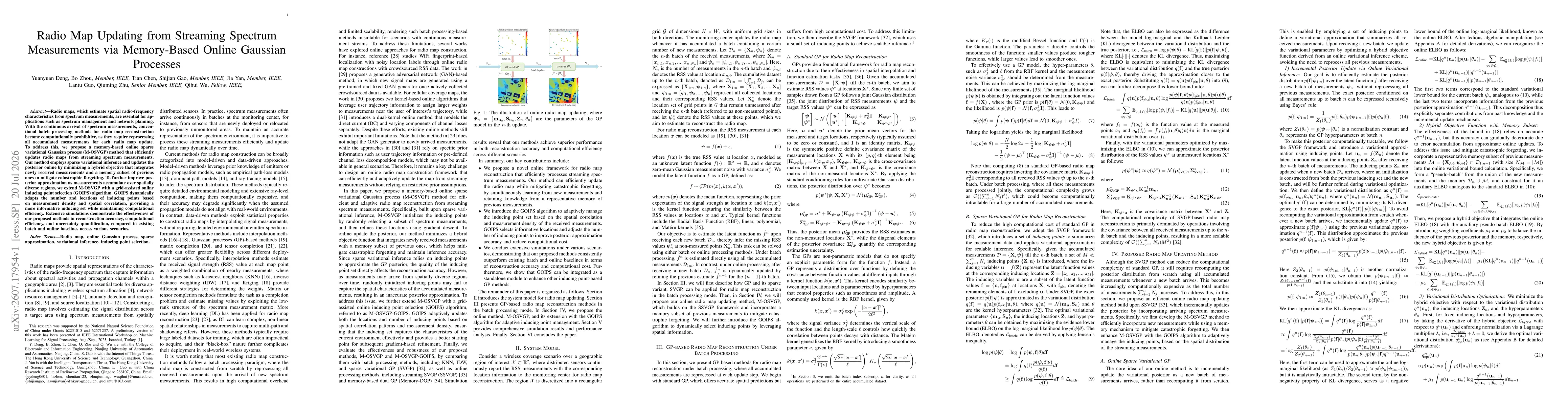
We introduce M-OSVGP, a memory-based online sparse variational Gaussian process framework for streaming radio map updating. The posterior is updated online via a hybrid objective that incorporates new measurements and a memory subset of previous data to mitigate forgetting, with a gradient-based refinement of inducing points. To further improve posterior quality over spatially diverse regions, we extend to GOIPS for grid-assisted online inducing point selection, which adaptively tunes both location and number of inducing points based on measurement density and spatial correlation, while maintaining computational efficiency.
SignificanceWhy the work matters
The proposed memory-based online variational framework enables scalable, accurate, and uncertainty-aware radiomap updates from continuous spectrum measurements, addressing the core bottlenecks of batch reprocessing and forgetting in streaming settings.
Technical contributionsWhat the work introduces
A memory-based online sparse variational GP (M-OSVGP) for radio map updating, with a hybrid online objective that fuses new streaming measurements and a memory subset; and GOIPS, a grid-assisted online inducing point selection algorithm that dynamically adjusts inducing points based on measurement density and spatial correlation to enhance posterior accuracy and efficiency.
NoveltyHow it differs from prior work
First integration of memory-based online variational inference with adaptive inducing point management (GOIPS) for streaming radiomap reconstruction, enabling efficient, accurate updates with uncertainty quantification and reduced catastrophic forgetting in spatially evolving measurement environments.
Future workQuestions that remain
- Investigate adaptive memory management strategies to further mitigate forgetting under highly dynamic scenarios.
- Explore extensions to non-stationary kernels and multi-task radiomaps to handle heterogeneous measurement modalities.
- Validate the approach on real-world streaming datasets and hardware-constrained implementations.
Discussion 0