RankCast: Phase-Aware Rank Balancing in MoE Serving
Abstract
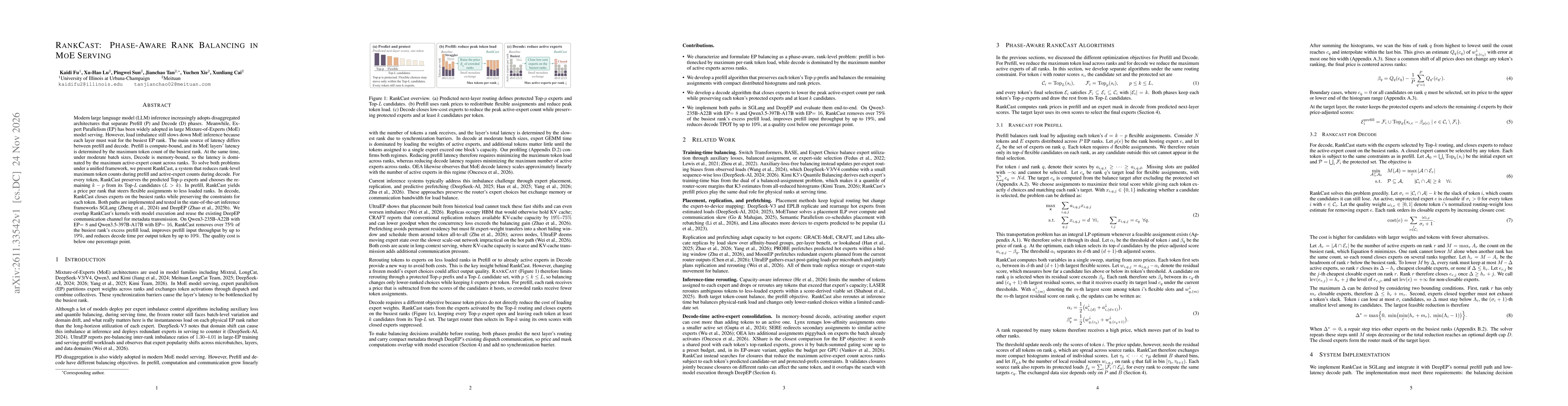
Modern large language model (LLM) inference increasingly adopts disaggregated architectures that separate Prefill (P) and Decode (D) phases. Meanwhile, Expert Parallelism (EP) has been widely adopted in large Mixture-of-Experts (MoE) model serving. However, load imbalance still slows down MoE inference because each layer must wait for the busiest EP rank. The main source of latency differs between prefill and decode. Prefill is compute-bound, and its MoE layers' latency is determined by the maximum token count of the busiest rank. At the same time, under moderate batch sizes, Decode is memory-bound, so the latency is dominated by the maximum active-expert count across ranks. To solve both problems under a unified framework, we present RankCast, a system that reduces rank-level maximum token counts during prefill and active-expert counts during decode. For every token, RankCast preserves the predicted Top-p experts and chooses the remaining k-p from its Top-L candidates (L > k). In prefill, RankCast yields a price per rank that steers flexible assignments to less loaded ranks. In decode, RankCast closes experts on the busiest ranks while preserving the constraints for each token. Both paths are implemented and tested in the state-of-the-art inference frameworks SGLang and DeepEP. We overlap RankCast's kernels with model execution and reuse the existing DeepEP communication channel for metadata transmission. On Qwen3-235B-A22B with EP=8 and Qwen3.5-397B-A17B with EP=16, RankCast removes over 75% of the busiest rank's excess prefill load, improves prefill input throughput by up to 19%, and reduces decode time per output token by up to 10%. The quality cost is below one percentage point.
AI Key Findings
Get AI-generated insights about this paper's methodology, results, significance, and more — available when analysis has been generated.
Discussion 0