This paper theoretically and experimentally investigates methods to suppress Rayleigh fading in one-dimensional optical scatters, particularly in phase-sensitive optical time-domain reflectometry (\Phi-OTDR). It proposes the use of M-degree summation of incoherent scattered light-waves to mitigate fading, demonstrating improved phase signal-to-noise ratio and reduced fluctuations.
Abstract
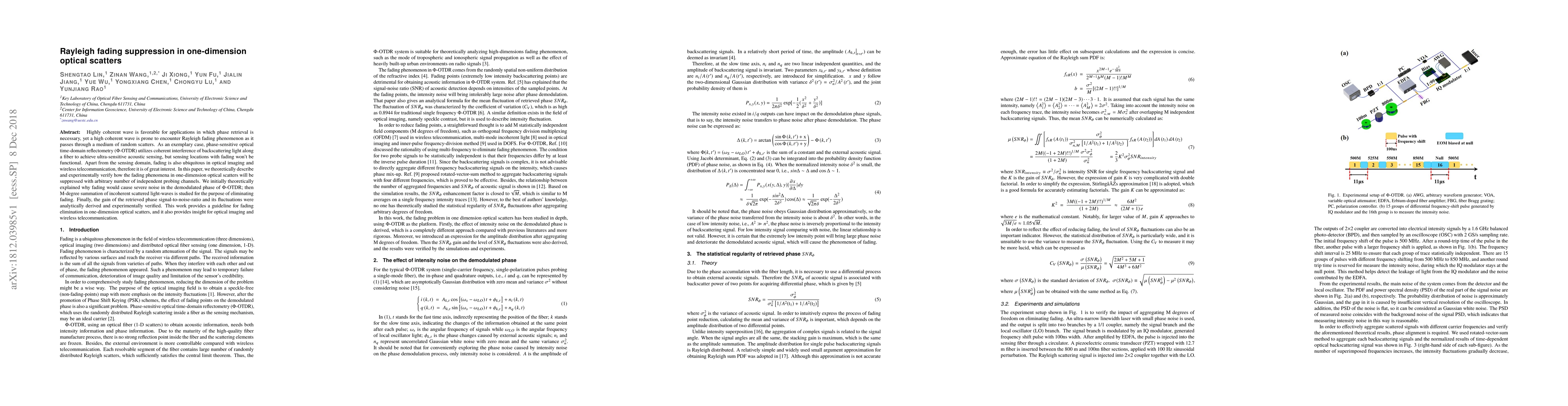
Highly coherent wave is favorable for applications in which phase retrieval is necessary, yet a high coherent wave is prone to encounter Rayleigh fading phenomenon as it passes through a medium of random scatters. As an exemplary case, phase-sensitive optical time-domain reflectometry (\Phi-OTDR) utilizes coherent interference of backscattering light along a fiber to achieve ultra-sensitive acoustic sensing, but sensing locations with fading won't be functional. Apart from the sensing domain, fading is also ubiquitous in optical imaging and wireless telecommunication, therefore it is of great interest. In this paper, we theoretically describe and experimentally verify how the fading phenomena in one-dimension optical scatters will be suppressed with arbitrary number of independent probing channels. We initially theoretically explained why fading would cause severe noise in the demodulated phase of \Phi-OTDR; then M-degree summation of incoherent scattered light-waves is studied for the purpose of eliminating fading. Finally, the gain of the retrieved phase signal-to-noise-ratio and its fluctuations were analytically derived and experimentally verified. This work provides a guideline for fading elimination in one-dimension optical scatters, and it also provides insight for optical imaging and wireless telecommunication.
AI Key Findings
Get AI-generated insights about this paper's methodology, results, significance, and more — available when analysis has been generated.
Discussion 0