Reading, Not Adapting: Unlocking Frozen Visual Knowledge for AI-Generated Image Detection
Abstract
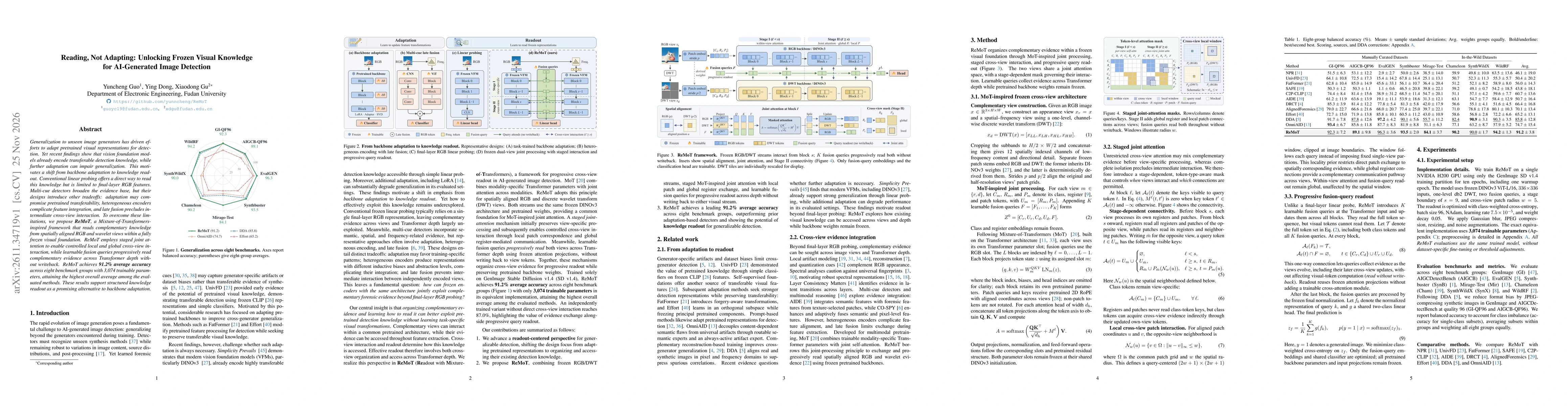
Generalization to unseen image generators has driven efforts to adapt pretrained visual representations for detection. Yet recent findings show that vision foundation models already encode transferable detection knowledge, while further adaptation can impair generalization. This motivates a shift from backbone adaptation to knowledge readout. Conventional linear probing offers a direct way to read this knowledge but is limited to final-layer RGB features. Multi-cue detectors broaden the evidence base, but their designs introduce other tradeoffs: adaptation may compromise pretrained transferability, heterogeneous encoders complicate feature integration, and late fusion precludes intermediate cross-view interaction. To overcome these limitations, we propose ReMoT, a Mixture-of-Transformers-inspired framework that reads complementary knowledge from spatially aligned RGB and wavelet views within a fully frozen visual foundation. ReMoT employs staged joint attention to enable controlled local and global cross-view interaction, while learnable fusion queries progressively read complementary evidence across Transformer depth without writeback. ReMoT achieves 91.2% average accuracy across eight benchmark groups with 3,074 trainable parameters, attaining the highest overall average among the evaluated methods. These results support structured knowledge readout as a promising alternative to backbone adaptation. Code is available at https://github.com/yunncheng/ReMoT.
Analysis
AI-generated · verify against the original paper
Generated Jan 1, 0001ResultsWhat the authors found
- ReMoT achieves 91.2% average balanced accuracy across eight benchmark groups with only 3,074 trainable parameters, the highest overall average among evaluated methods.
- A variant of ReMoT without direct cross‑view interaction reaches 87.0% average accuracy, highlighting the benefit of evidence exchange.
- Parameter optimizations reduce trainable parameters by up to 25% (from 4,098K to 3,074K) without affecting performance.
LimitationsWhere the findings need caution
- Performance is sensitive to the timing of cross‑view interaction; too early or too late interaction reduces accuracy.
- The approach relies on spatially aligned RGB and wavelet views, limiting applicability to modalities that can be aligned in this way.
MethodologyHow the work was done
ReMoT reads complementary knowledge from spatially aligned RGB and discrete wavelet transform (DWT) views within a fully frozen visual foundation model (DINOv3). It employs staged joint attention to first preserve view‑specific processing and then enable controlled local and global cross‑view interaction, while learnable fusion queries progressively read evidence across Transformer depth without writing back to the frozen tokens.
SignificanceWhy the work matters
The work demonstrates that frozen vision foundation models already encode highly transferable detection knowledge and that structured readout, rather than backbone adaptation, can substantially improve generalization to unseen AI‑generated image generators.
Technical contributionsWhat the work introduces
A Mixture‑of‑Transformers‑inspired framework that introduces staged joint attention and learnable fusion queries to read complementary forensic evidence from frozen dual‑view representations without modifying the backbone.
NoveltyHow it differs from prior work
First method to unlock and read frozen visual knowledge from both RGB and wavelet domains using progressive query‑based cross‑view interaction, shifting detection design from backbone adaptation to knowledge readout.
Discussion 0