Reasoning Topology Matters: A Controlled Study of LLM-Based Cybersecurity Analysis
Abstract
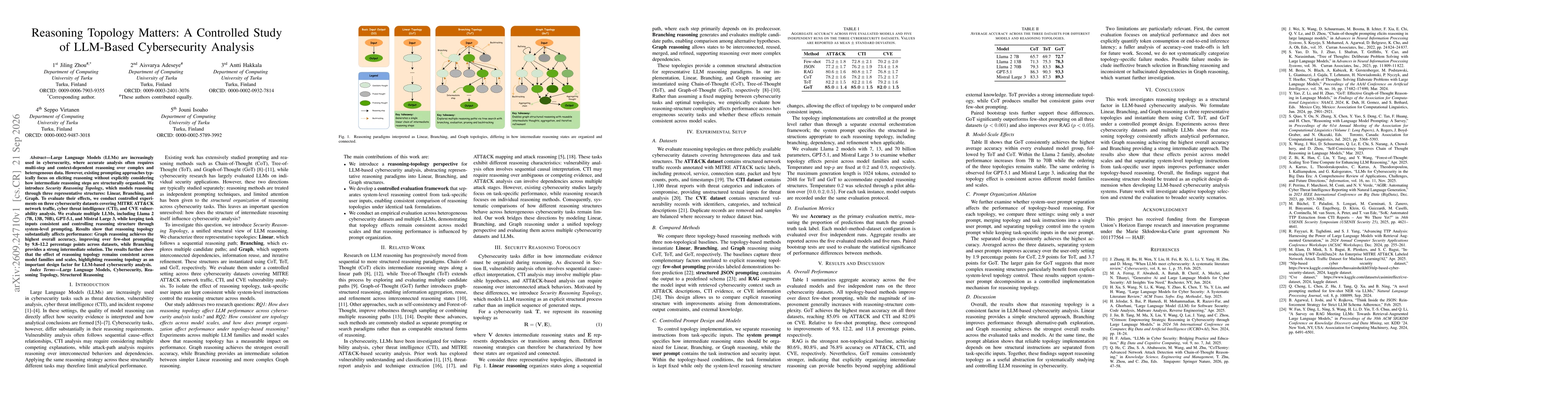
Large Language Models (LLMs) are increasingly used in cybersecurity, where accurate analysis often requires multi-step and context-dependent reasoning over complex and heterogeneous data. However, existing prompting approaches typically focus on eliciting reasoning without explicitly considering how intermediate reasoning steps are structurally organized. We introduce Security Reasoning Topology, which models reasoning through three representative structures: Linear, Branching, and Graph. To evaluate their effects, we conduct controlled experiments on three cybersecurity datasets covering MITRE ATT&CK network traffic, cyber threat intelligence (CTI), and CVE vulnerability analysis. We evaluate multiple LLMs, including Llama 2 (7B, 13B, 70B), GPT-5.1, and Mistral Large 3, while keeping task inputs consistent and controlling reasoning structure through system-level prompting. Results show that reasoning topology substantially affects performance: Graph reasoning achieves the highest overall accuracy, improving over few-shot prompting by 9.8-12.2 percentage points across datasets, while Branching provides a strong intermediate solution. The results further show that the effect of reasoning topology remains consistent across model families and scales, highlighting reasoning topology as an important design factor for LLM-based cybersecurity analysis.
AI Key Findings
Get AI-generated insights about this paper's methodology, results, significance, and more — available when analysis has been generated.
Discussion 0