RecallFlow: Episodic Memory as the Source Distribution of Generative Robot Policies
Abstract
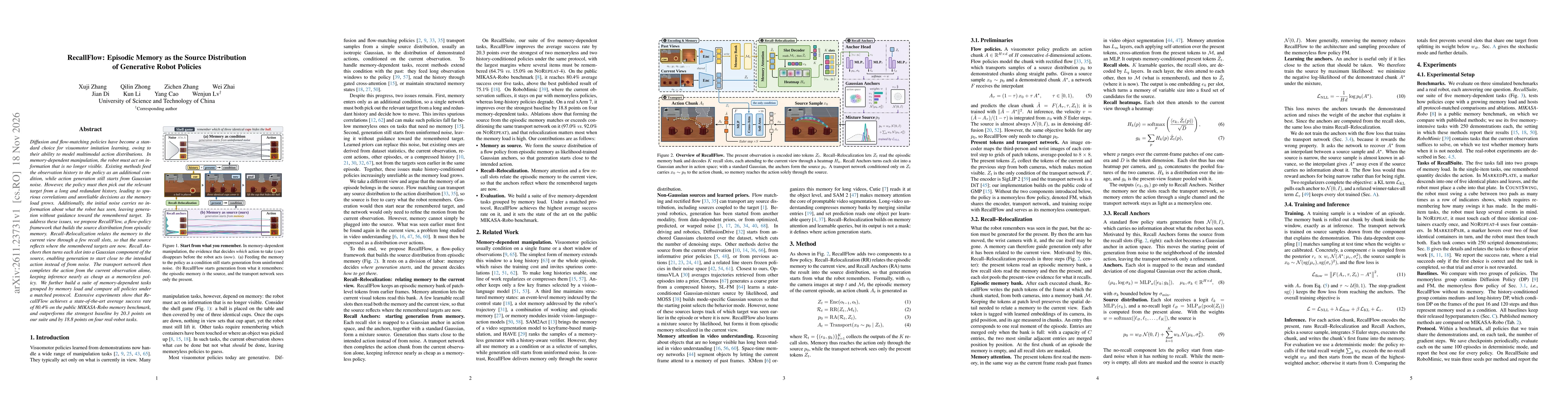
Diffusion and flow-matching policies have become a standard choice for visuomotor imitation learning, owing to their ability to model multimodal action distributions. In memory-dependent manipulation, the robot must act on information that is no longer visible. Existing methods feed the observation history to the policy as an additional condition, while action generation still starts from Gaussian noise. However, the policy must then pick out the relevant target from a long and redundant history, leading to spurious correlations and unreliable decisions as the memory load grows. Additionally, the initial noise carries no information about what the robot has seen, leaving generation without guidance toward the remembered target. To address these issues, we propose RecallFlow, a flow-policy framework that builds the source distribution from episodic memory. Recall-Relocalization relates the memory to the current view through a few recall slots, so that the source reflects where the remembered targets are now. Recall Anchors then turns each slot into a Gaussian component of the source, enabling generation to start close to the intended action instead of from noise. The transport network then completes the action from the current observation alone, keeping inference nearly as cheap as a memoryless policy. We further build a suite of memory-dependent tasks grouped by memory load and compare all policies under a matched protocol. Extensive experiments show that RecallFlow achieves a state-of-the-art average success rate of 80.4% on the public MIKASA-Robo memory benchmark, and outperforms the strongest baseline by 20.3 points on our suite and by 18.8 points on four real-robot tasks.
Analysis
AI-generated · verify against the original paper
Generated Jan 1, 0001ResultsWhat the authors found
- Achieves 80.4% average success on the public MIKASA‑Robo memory benchmark, surpassing the previous best of 75.1%.
- Outperforms the strongest baseline by 20.3 percentage points on the authors' RecallSuite and by 18.8 points on four real‑robot tasks.
- Ablation studies show that using the memory‑derived source improves success from 92.0% to 97.0% on the NOREPEAT task, and that Recall‑Relocalization is the most critical component under high memory load.
- Inference latency is 153.7 ms per action chunk with 1.1 GB GPU memory, comparable to other flow‑matching baselines.
LimitationsWhere the findings need caution
- Performance degrades when the memory module is disabled (e.g., 6% success without memory), indicating reliance on accurate memory retrieval.
- Inference cost is higher than some memory‑less baselines, requiring a GPU with ~1 GB memory and ~150 ms latency per action chunk.
MethodologyHow the work was done
RecallFlow builds a flow‑matching policy whose source distribution is derived from an episodic memory bank. A memory‑attention module reads patch‑level tokens from past frames, and a few learnable recall slots relate this memory to the current view (Recall‑Relocalization). Each slot is mapped to a Gaussian anchor in action space (Recall Anchors), forming a mixture source that replaces uninformed Gaussian noise. A transport network then refines the action conditioned only on the current observation, keeping inference cost comparable to memory‑less policies.
SignificanceWhy the work matters
RecallFlow demonstrates that episodic memory can serve as an informative source distribution for generative policies, eliminating the need for uninformed noise and reducing spurious correlations in memory‑heavy manipulation, thereby setting a new performance standard for memory‑dependent robot learning.
Technical contributionsWhat the work introduces
Introduces a memory‑as‑source paradigm for flow‑matching policies, with novel Recall‑Relocalization and Recall Anchors mechanisms that map episodic visual tokens to Gaussian action priors, and validates the approach on a comprehensive suite of memory‑dependent tasks.
NoveltyHow it differs from prior work
First work to construct the source distribution of a flow‑matching robot policy directly from episodic memory, enabling generation to start near the remembered target rather than from uninformed noise.
Discussion 0