Recent Lattice QCD Results from the UKQCD Collaboration
The UKQCD collaboration utilized lattice QCD simulations to predict the hadronic spectrum, employing unquenched methods and presenting novel techniques for spectral extraction, alongside comparisons with quenched data.
Abstract
The lattice technique of studying the strong interaction of matter is used to obtain predictions of the hadronic spectrum. These simulations were performed by the UKQCD collaboration using full (unquenched) QCD. Details of the results, a comparison with quenched data, and novel methods of extracting spectral properties are described.
Analysis
AI-generated · verify against the original paper
Generated Sep 5, 2025ResultsWhat the authors found
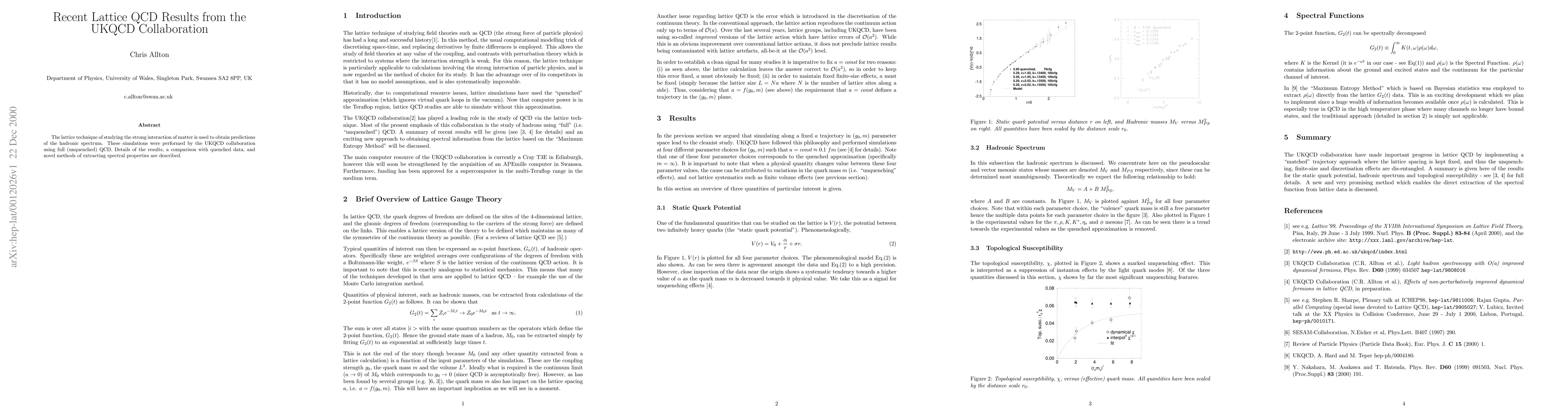
- Static quark potential shows a systematic tendency towards a higher value of α as the quark mass decreases towards its physical value.
- Hadronic spectrum shows a trend towards experimental values as the quenched approximation is removed.
- Topological susceptibility shows significant unquenching features, interpreted as suppression of instanton effects by light quark modes.
LimitationsWhere the findings need caution
- The quenched approximation is still used for some parameter choices, which can lead to unquenching effects.
- Finite-size effects are not fully eliminated due to the limited number of configurations.
MethodologyHow the work was done
The UKQCD collaboration used a matched trajectory approach where the lattice spacing is kept fixed to eliminate unquenching, finite-size, and discretization effects.
SignificanceWhy the work matters
This research makes important progress in lattice QCD by implementing a matched trajectory approach and extracting spectral functions directly from lattice data.
Technical contributionsWhat the work introduces
The implementation of a matched trajectory approach to eliminate unquenching, finite-size, and discretization effects in lattice QCD.
NoveltyHow it differs from prior work
The direct extraction of spectral functions from lattice data using the Maximum Entropy Method, which is particularly useful in QCD at high temperatures.
Future workQuestions that remain
- Further studies on the spectral functions extracted using the Maximum Entropy Method
- Investigating the impact of non-perturbatively improved dynamical fermions on lattice QCD
Discussion 0