REDI-Match: Rotation-Equivariant Distillation for Efficient and Robust Dense Matching
Abstract
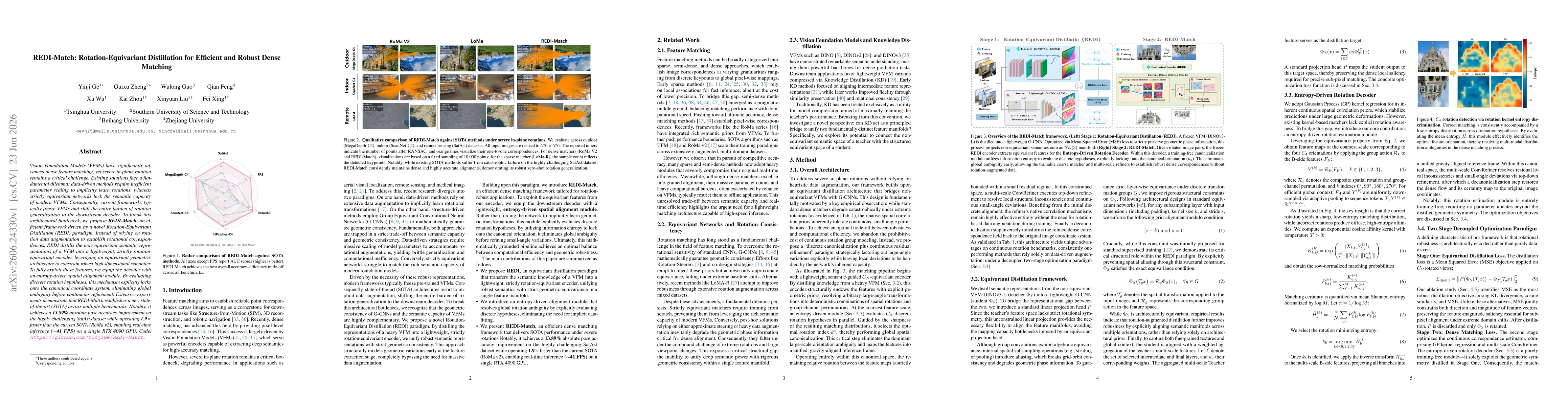
Vision Foundation Models (VFMs) have significantly advanced dense feature matching, yet severe in-plane rotation remains a critical challenge. Existing solutions face a fundamental dilemma: data-driven methods require inefficient parameter scaling to implicitly learn rotations, whereas strictly equivariant networks lack the semantic capacity of modern VFMs. Consequently, current frameworks typically freeze VFMs and shift the entire burden of rotation generalization to the downstream decoder. To break this architectural bottleneck, we propose REDI-Match, an efficient framework driven by a novel Rotation-Equivariant Distillation (REDI) paradigm. Instead of relying on rotation data augmentation to establish rotational correspondences, REDI distills the non-equivariant semantic representations of a VFM into a lightweight, strictly rotation-equivariant encoder, leveraging an equivariant geometric architecture to constrain robust high-dimensional semantics. To fully exploit these features, we equip the decoder with an entropy-driven spatial alignment module. By evaluating discrete rotation hypotheses, this mechanism explicitly locks onto the canonical coordinate system, eliminating global ambiguity before continuous refinement. Extensive experiments demonstrate that REDI-Match establishes a new state-of-the-art (SOTA) across multiple benchmarks. Notably, it achieves a 13.89% absolute pose accuracy improvement on the highly challenging SatAst dataset while operating 1.9x faster than the current SOTA (RoMa v2), enabling real-time inference (~41 FPS) on a single RTX 4090 GPU. Code: https://github.com/YinjiGe/REDI-Match.
Analysis
AI-generated · verify against the original paper
Generated Jun 25, 2026ResultsWhat the authors found
- Achieves state-of-the-art performance across multiple benchmarks under severe rotations, outperforming previous methods in accuracy and robustness.
- On the SatAst dataset, REDI-Match delivers a 13.89% absolute pose accuracy improvement over the prior SOTA RoMa v2 while running 1.9x faster, enabling real-time inference (~41 FPS) on a single RTX 4090.
- Demonstrates efficient real-time dense matching by leveraging the rotation-equivariant encoder and entropy-driven alignment, reducing computational burden without sacrificing accuracy.
LimitationsWhere the findings need caution
- Evaluation is concentrated on specific datasets (e.g., SatAst); generalization to unseen domains with extreme rotations or occlusions requires further validation.
- Reliance on a pre-trained VFM; performance may vary with different foundation models or if distillation quality degrades.
- Potential sensitivity to the discretization of rotation hypotheses; very fine-grained rotations may still present challenges if discretization granularity is limited.
MethodologyHow the work was done
REDI-Match introduces Rotation-Equivariant Distillation (REDI) to transfer semantic knowledge from a Vision Foundation Model into a lightweight encoder that is strictly rotation-equivariant. An entropy-driven spatial alignment module in the decoder evaluates discrete rotation hypotheses to lock onto a canonical orientation before refinement, reducing global rotational ambiguity. The framework combines an equivariant geometric architecture with distillation to maintain semantic richness while ensuring geometric consistency, enabling efficient, rotation-robust dense matching.
SignificanceWhy the work matters
Demonstrates that distilling non-equivariant semantic representations into a strictly rotation-equivariant encoder, coupled with an entropy-based alignment module, can break the semantic-vs-geometric trade-off in dense matching. This enables robust rotation-generalization and real-time inference, advancing practical deployment of dense matching in rotated scenarios and challenging datasets.
Technical contributionsWhat the work introduces
A novel Rotation-Equivariant Distillation (REDI) paradigm that distills non-equivariant VFM semantics into a lightweight strictly rotation-equivariant encoder, and an entropy-driven spatial alignment module in the decoder that explicitly evaluates discrete rotation hypotheses to resolve canonical orientation prior to refinement.
NoveltyHow it differs from prior work
Pairs a rotation-equivariant geometric encoder with semantic distillation from VFMs and couples it with an entropy-based discrete rotation hypothesis mechanism, enabling state-of-the-art dense matching under rotation while maintaining real-time efficiency.
Future workQuestions that remain
- Investigate adaptive rotation hypothesis sampling to further improve alignment in highly variable rotation conditions.
- Extend REDI-Match to multi-view or sequential data to exploit temporal coherence for even more robust dense matching.
- Explore alternative equivariant architectures and distillation strategies to handle non-rotation nuisances (scale, viewpoint, illumination).
Discussion 0