Reference-Model-Guided Distributed MPC for UAV Swarm Formation Flying Under Switching Directed Graphs
Abstract
Distributed formation control of unmanned aerial vehicle (UAV) swarms in complex environments faces several challenges, including switching inter-agent connectivity, limited communication, external disturbances, and collision avoidance. To address these challenges, we propose a reference-model-guided distributed model predictive control (MPC) framework for UAV swarm formation. Each UAV uses relative-position information from its neighbors as input to a local reference model, whose output serves as the formation guidance for the onboard MPC controller. Meanwhile, a Kalman filter is utilized to predict neighboring UAV motions, enabling the construction of inter-UAV collision-avoidance constraints solely from instantaneous relative-state information. By decoupling MPC optimization from distributed coordination, this control architecture preserves the look-ahead planning and constraint-handling capabilities of MPC while enhancing the swarm's adaptability to switching directed graphs. Moreover, eliminating the exchange of neighbors' predicted trajectories reduces communication bandwidth demands, offering strong scalability for large-scale UAV swarms. To improve robustness and safety, disturbance-observer-based feedforward compensation is employed, while the bounded residual disturbance is explicitly considered in the control barrier function (CBF)-based obstacle-avoidance constraints. Finally, the proposed framework is validated through both simulations and real-world flight experiments. Specifically, the flight verification is conducted on a fully distributed multi-UAV platform without external global localization.
Analysis
AI-generated · verify against the original paper
Generated Jan 1, 0001ResultsWhat the authors found
- The proposed framework achieves formation flying under switching directed graphs with reduced communication bandwidth by eliminating trajectory exchange.
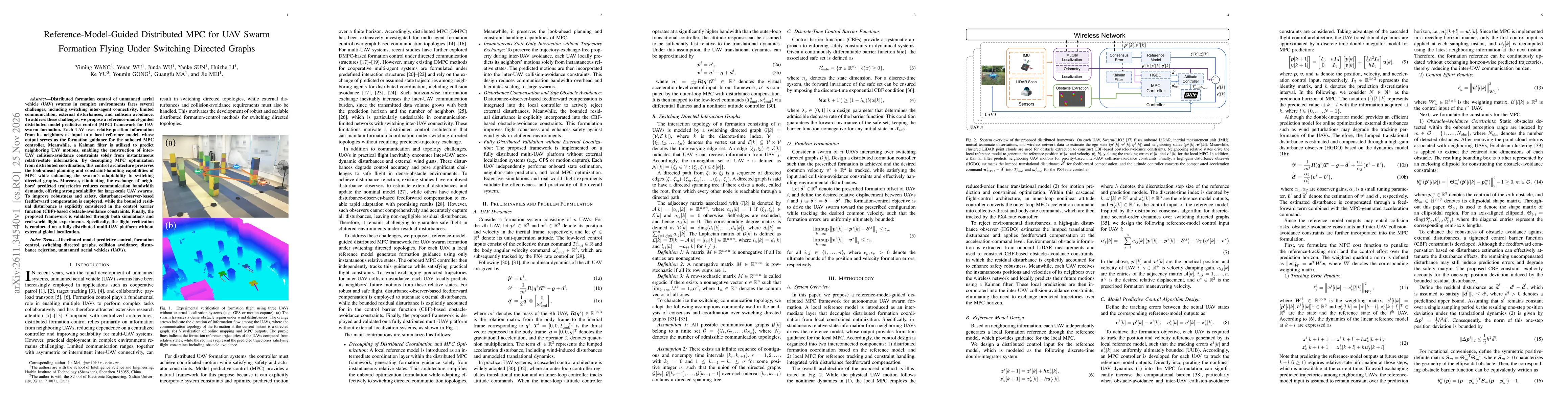
- Simulation and real‑world flight experiments with a fully distributed multi‑UAV platform (without GPS or motion‑capture) validate robustness to wind disturbances and collision avoidance.
- The approach scales to larger swarms due to its reliance only on instantaneous relative states and local predictions.
LimitationsWhere the findings need caution
- The current validation is performed on a modest‑size swarm and may need further testing for very large numbers of UAVs.
- Reliance on accurate relative‑state measurements and Kalman‑filter predictions may be challenged by severe sensor noise or occlusions.
MethodologyHow the work was done
A reference-model-guided distributed model predictive control (MPC) framework where each UAV runs a local reference model using instantaneous relative-position data from neighbors; the reference output guides an onboard MPC controller. A Kalman filter predicts neighbor motions to form collision‑avoidance constraints without exchanging predicted trajectories. Disturbance‑observer‑based feedforward compensation mitigates external disturbances, and bounded residual disturbances are incorporated into control‑barrier‑function (CBF) based obstacle‑avoidance constraints. The architecture decouples MPC optimization from distributed coordination, preserving look‑ahead planning while adapting to switching directed communication graphs.
SignificanceWhy the work matters
Enables robust, scalable distributed formation control for UAV swarms in complex, communication‑limited environments without requiring external global localization, advancing practical deployment of autonomous aerial swarms.
Technical contributionsWhat the work introduces
Introduces a decoupled distributed coordination layer via local reference models, enabling trajectory‑free interaction and reduced communication, while embedding disturbance observer feedforward compensation and CBF‑based safety constraints within the MPC loop.
NoveltyHow it differs from prior work
First to combine reference‑model guidance based solely on instantaneous relative states with distributed MPC that handles switching directed graphs without exchanging predicted trajectories, and to explicitly account for bounded residual disturbances in CBF constraints.
Future workQuestions that remain
- Integrate the framework with advanced autonomous perception and decision‑making modules for more complex real‑world applications.
Discussion 0