Reflection-Based Relative Localization for Cooperative UAV Teams Using Active Markers
Abstract
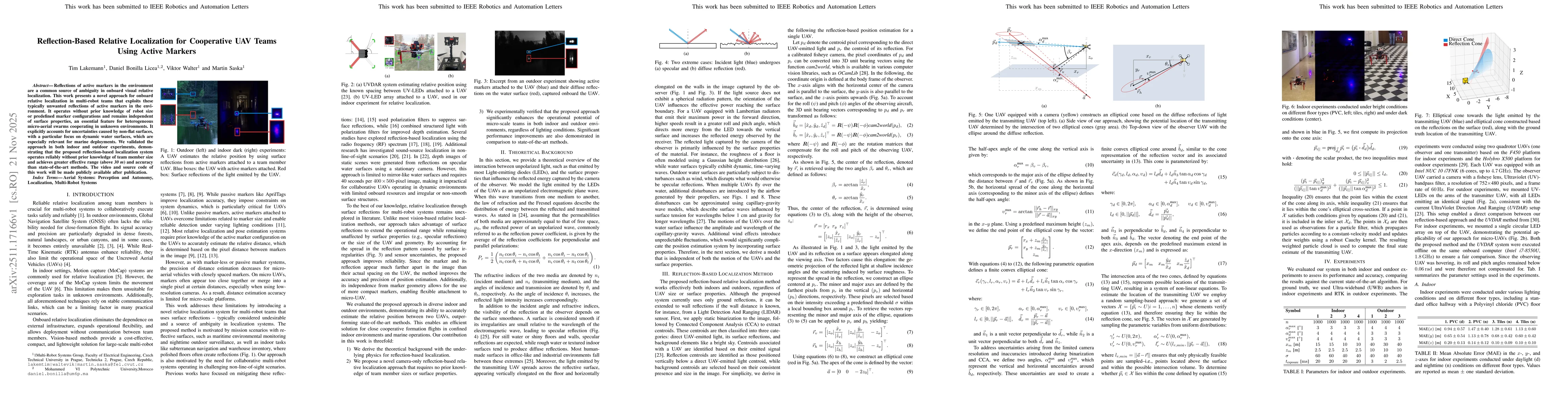
Reflections of active markers in the environment are a common source of ambiguity in onboard visual relative localization. This work presents a novel approach that exploits these typically unwanted reflections for onboard relative localization in heterogeneous multi-UAV teams operating over specular, near-planar surfaces such as calm water and flat indoor floors. Using only a camera, active markers, and a single-beam rangefinder, the method requires no prior knowledge of robot size, marker configuration, or surface reflectance properties, and propagates the uncertainty introduced by surface irregularities, including those of dynamic water surfaces. We further characterize, analytically and experimentally, how surface tilt biases the estimate, and identify the slope range over which the level-surface assumption holds. Indoor multi-UAV and outdoor experiments validate the localization accuracy, demonstrating reliable operation across varying lighting conditions and greater effective range than state-of-the-art vision-based active-marker methods, with higher accuracy beyond 30 m. The project website with the video is available at: https://timlakemann.github.io/reflection-based-relative-localization/.
AI Key Findings
Get AI-generated insights about this paper's methodology, results, significance, and more — available when analysis has been generated.
Discussion 0