Reglos: A Self-Evolving Personal Memory Agent with Recursive Self-Improvement
Abstract
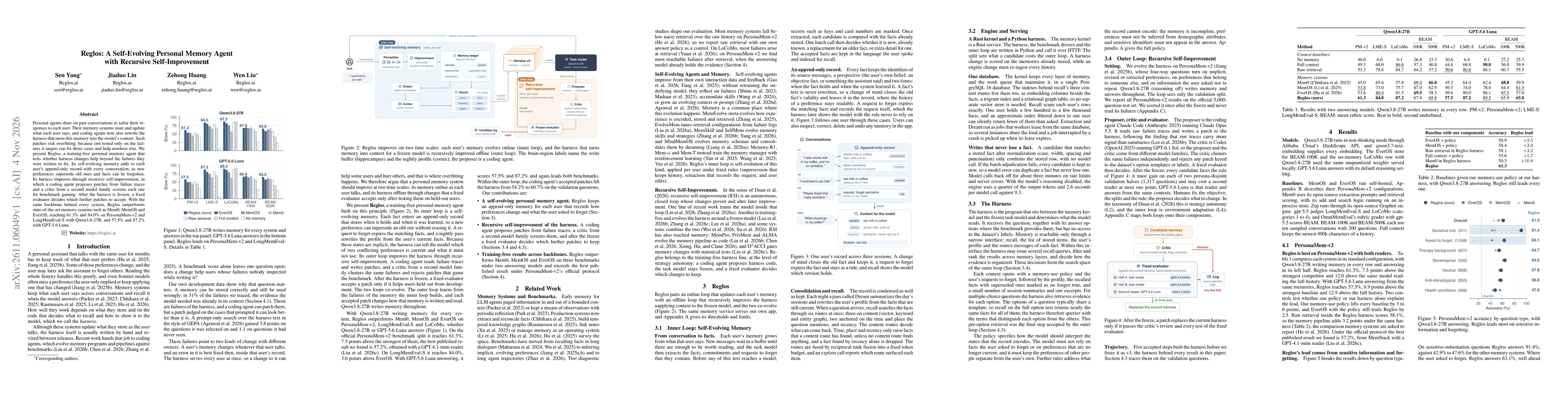
Personal agents draw on past conversations to tailor their responses to each user. Their memory systems store and update what each user says, and coding agents now also rewrite the harness that turns this memory into the model's context. Such patches risk overfitting, because one tested only on the failures it targets can fix those cases and help nowhere else. We present Reglos, a training-free personal memory agent that tests whether harness changes help beyond the failures they were written to fix. Its self-evolving memory adds to each user's append-only record with every conversation, as new preferences supersede old ones and facts can be forgotten. Its harness improves through recursive self-improvement, in which a coding agent proposes patches from failure traces and a critic from a second model family screens each one for benchmark gaming. After the harness is frozen, a fixed evaluator decides which further patches to accept. With the same backbone behind every system, Reglos outperforms state-of-the-art memory systems such as Mem0, MemOS and EverOS, reaching 61.3% and 84.0% on PersonaMem-v2 and LongMemEval-S with Qwen3.8-27B, and 57.5% and 87.2% with GPT-5.6 Luna.
Analysis
AI-generated · verify against the original paper
Generated Jan 1, 0001ResultsWhat the authors found
- Reglos achieves 61.3% on PersonaMem‑v2 and 84.0% on LongMemEval‑S using Qwen3.8‑27B, surpassing Mem0, MemOS and EverOS.
- With GPT‑5.6 Luna, Reglos reaches 57.5% on PersonaMem‑v2 and 87.2% on LongMemEval‑S, again leading the benchmarks.
- The coding‑agent patches raise harness performance from 54.2% to 60.7% on validation questions.
LimitationsWhere the findings need caution
- Patches may help some users while hurting others, indicating residual overfitting risk.
- Evaluation is limited to benchmark datasets and held‑out user splits, not full real‑world deployment.
- The system relies on a second‑family critic for patch screening, which may constrain generality.
MethodologyHow the work was done
Reglos combines an inner loop self‑evolving append‑only memory that records user facts with timestamps and supports superseding preferences and forgetting, with an outer loop recursive self‑improvement of the harness where a coding agent proposes patches from failure traces and a critic from a second model family screens them before a frozen evaluator accepts only those that improve held‑out users.
SignificanceWhy the work matters
The training‑free, dual‑loop approach demonstrates that personal memory agents can improve both online user‑specific memory and offline harness logic without overfitting to observed failures, setting new state‑of‑the‑art results across multiple benchmarks and model backbones.
Technical contributionsWhat the work introduces
Introduces a self‑evolving personal memory architecture with explicit append‑only records and a recursive self‑improvement harness that autonomously generates, critiques, and validates code patches to improve memory utilization.
NoveltyHow it differs from prior work
First training‑free personal memory agent that co‑evolves user‑level memory online and harness code offline via a dual‑loop, critic‑screened patching process, mitigating overfitting to observed failures.
Future workQuestions that remain
- Explore broader user studies and real‑world deployments to assess generalization beyond benchmarks.
- Investigate more sophisticated forgetting and conflict‑resolution mechanisms in the append‑only memory.
- Extend the recursive self‑improvement framework to incorporate additional model families and reduce reliance on a single critic.
Discussion 0