Abstract
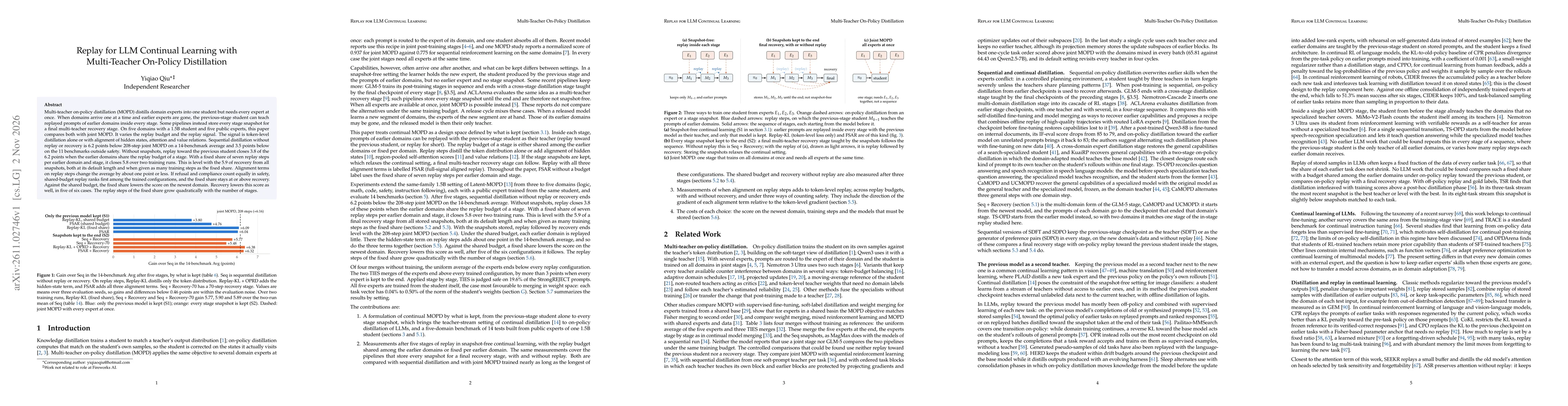
Multi-teacher on-policy distillation (MOPD) distills several domain experts into one student and is used in the post-training of recent large language models. It trains on all domains at once, so every expert must be available at the same time. In practice, capabilities often arrive one after another, and the experts of earlier domains may be gone when a new domain is learned. Distilling the experts in sequence then suffers from catastrophic forgetting of the earlier domains. Some recent pipelines store a snapshot after every stage and end with a multi-teacher recovery stage taught by all snapshots. The number of stored models then grows with the number of stages. Different from these pipelines, this paper formulates continual MOPD by what is kept from earlier stages and studies replay toward the previous student. Inside every stage, prompts of earlier domains are replayed with the student of the previous stage as their teacher, so neither earlier experts nor stage snapshots are kept. Two design choices of replay are explored. The replay budget of a stage is either shared among the earlier domains or fixed per earlier domain. Replay steps either distill the token distribution alone or add alignment of hidden states, region-pooled self-attention scores and value relations. A five-domain benchmark of logic, math, code, safety and instruction following is built from public experts of one 1.5B student. Experiments on its 14 benchmarks show that, without storing any snapshot, replay toward the previous student closes most of the gap between sequential distillation and joint MOPD. With a fixed replay share per earlier domain, it performs on par with recovery from all stored snapshots.
Analysis
AI-generated · verify against the original paper
Generated Jan 1, 0001ResultsWhat the authors found
- Replay without storing any snapshots closes most of the performance gap between sequential distillation and joint MOPD, recovering 3.8 points on average under a shared budget.
- With a fixed replay share (seven steps per earlier domain), replay achieves 5.8 points gain, matching the performance of a final recovery stage that uses all stored snapshots.
- Under the shared‑budget setting, adding hidden‑state alignment adds about one point to the 14‑benchmark average, and all three alignment terms together provide similar improvements.
- Fixed‑share replay performs slightly worse on the newest domain compared to shared‑budget replay, and the replay steps grow quadratically with the number of stages.
LimitationsWhere the findings need caution
- Fixed‑share replay lowers performance on the most recent domain relative to shared‑budget replay.
- Replay steps increase quadratically with the number of stages, potentially limiting scalability.
MethodologyHow the work was done
Inside each continual learning stage, prompts from earlier domains are replayed using the student model from the previous stage as the teacher, eliminating the need to store earlier experts or stage snapshots. Two replay budget strategies are explored: a shared budget across earlier domains or a fixed budget per earlier domain. Replay steps either distill only token distributions or also align hidden states, region‑pooled self‑attention scores, and value relations (FSAR).
SignificanceWhy the work matters
The study demonstrates that continual multi‑teacher on‑policy distillation can be performed without retaining any expert models or snapshots, greatly reducing storage requirements while maintaining performance comparable to joint training and snapshot‑based recovery.
Technical contributionsWhat the work introduces
Formulation of continual MOPD that keeps only the previous‑stage student model, introduction of replay‑based distillation with configurable budgets and alignment terms, and creation of a five‑domain benchmark with 14 evaluation tasks for LLM continual learning.
NoveltyHow it differs from prior work
Introducing snapshot‑free replay toward the previous student as a means to mitigate catastrophic forgetting in multi‑teacher on‑policy distillation, enabling continual learning without storing expert models.
Discussion 0