Rethinking Clustering-Based Pseudo-Labeling for Unsupervised Meta-Learning
This paper proposes an enhanced clustering-based pseudo-labeling method for unsupervised meta-learning, addressing label inconsistency and diversity issues by optimizing embedding space for better clustering. The approach significantly improves performance across few-shot benchmarks when integrated with MAML and EP.
Abstract
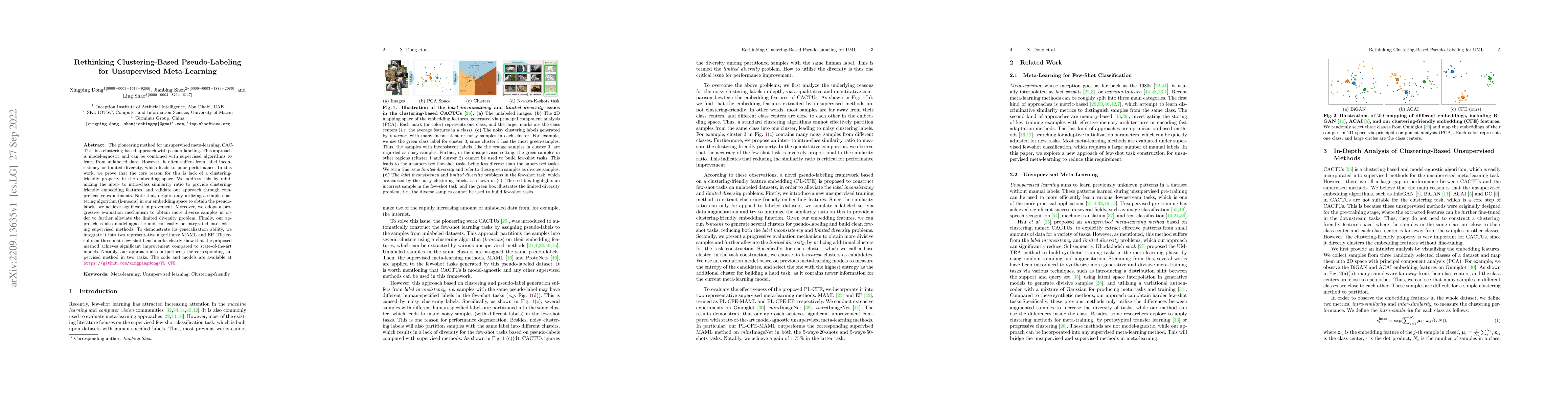
The pioneering method for unsupervised meta-learning, CACTUs, is a clustering-based approach with pseudo-labeling. This approach is model-agnostic and can be combined with supervised algorithms to learn from unlabeled data. However, it often suffers from label inconsistency or limited diversity, which leads to poor performance. In this work, we prove that the core reason for this is lack of a clustering-friendly property in the embedding space. We address this by minimizing the inter- to intra-class similarity ratio to provide clustering-friendly embedding features, and validate our approach through comprehensive experiments. Note that, despite only utilizing a simple clustering algorithm (k-means) in our embedding space to obtain the pseudo-labels, we achieve significant improvement. Moreover, we adopt a progressive evaluation mechanism to obtain more diverse samples in order to further alleviate the limited diversity problem. Finally, our approach is also model-agnostic and can easily be integrated into existing supervised methods. To demonstrate its generalization ability, we integrate it into two representative algorithms: MAML and EP. The results on three main few-shot benchmarks clearly show that the proposed method achieves significant improvement compared to state-of-the-art models. Notably, our approach also outperforms the corresponding supervised method in two tasks.
AI Key Findings
Get AI-generated insights about this paper's methodology, results, significance, and more — available when analysis has been generated.
Discussion 0