Reverse to Advance: Teleoperation-Cost Effective Hard Policy Learning from Reversed Easy Tasks
The paper presents a teleoperation-efficient approach to learning hard manipulation policies by using reversed, easier tasks as supervision. It combines automated data collection, hierarchical data refinement to filter reversed trajectories, and iterative learning, achieving higher success and data efficiency on hard tasks in simulation and real robots compared to reversal-based and RL baselines.
Abstract
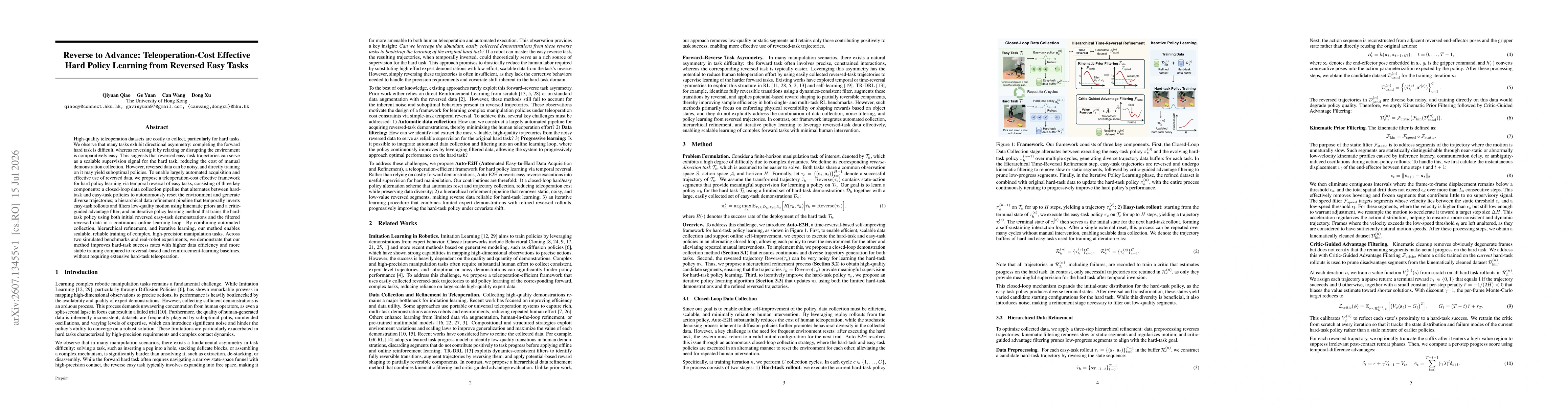
High-quality teleoperation datasets are costly to collect, particularly for hard tasks. We observe that many tasks exhibit directional asymmetry: completing the forward hard task is difficult, whereas reversing it by relaxing or disrupting the environment is comparatively easy. This suggests that reversed easy-task trajectories can serve as a scalable supervision signal for the hard task, reducing the cost of manual demonstration collection. However, reversed data can be noisy, and directly training on it may yield suboptimal policies. To enable largely automated acquisition and effective use of reversed data, we propose a teleoperation-cost effective framework for hard policy learning via temporal reversal of easy tasks, consisting of three key components: a closed-loop data collection pipeline that alternates between hard-task and easy-task policies to autonomously reset the environment and generate diverse trajectories; a hierarchical data refinement pipeline that temporally inverts easy-task rollouts and filters low-quality motion using kinematic priors and a critic-guided advantage filter; and an iterative policy learning method that trains the hard-task policy using both initial reversed easy-task demonstrations and the filtered reversed data in a continuous online learning loop. By combining automated collection, hierarchical refinement, and iterative learning, our method enables scalable, reliable training of complex, high-precision manipulation tasks. Across two simulated benchmarks and real-robot experiments, we demonstrate that our method improves hard-task success rates with higher data efficiency and more stable training compared to reversal-based and reinforcement-learning baselines, without requiring extensive hard-task teleoperation.
Analysis
AI-generated · verify against the original paper
Generated Jul 17, 2026ResultsWhat the authors found
- Across two simulated benchmarks and real-robot experiments, the proposed method improves hard-task success rates.
LimitationsWhere the findings need caution
- Evaluation is limited to two simulated benchmarks and a real-robot setup; generalization to broader task families remains to be validated.
- The reliance on temporal reversal assumptions may be sensitive to task dynamics and noise in reversed trajectories.
MethodologyHow the work was done
The paper presents a teleoperation-cost effective framework (Auto-E2H) that learns hard manipulation policies by leveraging temporal reversal of easy tasks. It integrates (1) a closed-loop data collection pipeline that alternates between hard-task and easy-task policies to autonomously reset the environment and generate diverse trajectories, (2) a hierarchical data refinement pipeline that temporally inverts easy-task rollouts and filters low-quality motion using kinematic priors and a critic-guided advantage filter, and (3) an iterative policy learning method that trains the hard-task policy using both initial reversed easy-task demonstrations and the filtered reversed data in a continuous online loop.
SignificanceWhy the work matters
The approach enables scalable and reliable training of complex, high-precision manipulation tasks with reduced teleoperation cost by exploiting reversed easy-task data and an automated refinement and online-learning loop.
Technical contributionsWhat the work introduces
A three-component framework combining automated closed-loop data collection, hierarchical data refinement with kinematic priors and critic-guided filtering, and iterative online learning that fuses initial reversed demonstrations with refined reversed data to learn hard-task policies.
NoveltyHow it differs from prior work
Introduces a teleoperation-cost efficient pipeline that exploits temporal reversal of easy tasks for hard task learning, integrating automated data collection, hierarchical refinement, and continuous online policy improvement in a cohesive avoidance of extensive hard-task teleoperation.
Future workQuestions that remain
- Extend the framework to a wider range of manipulation tasks and robot platforms to assess generalizability.
- Investigate more sophisticated refinement criteria or priors to further filter reversed data under diverse noise conditions.
Discussion 0