Reward Basis Decomposition for Interpreting Preference Heterogeneity
Abstract
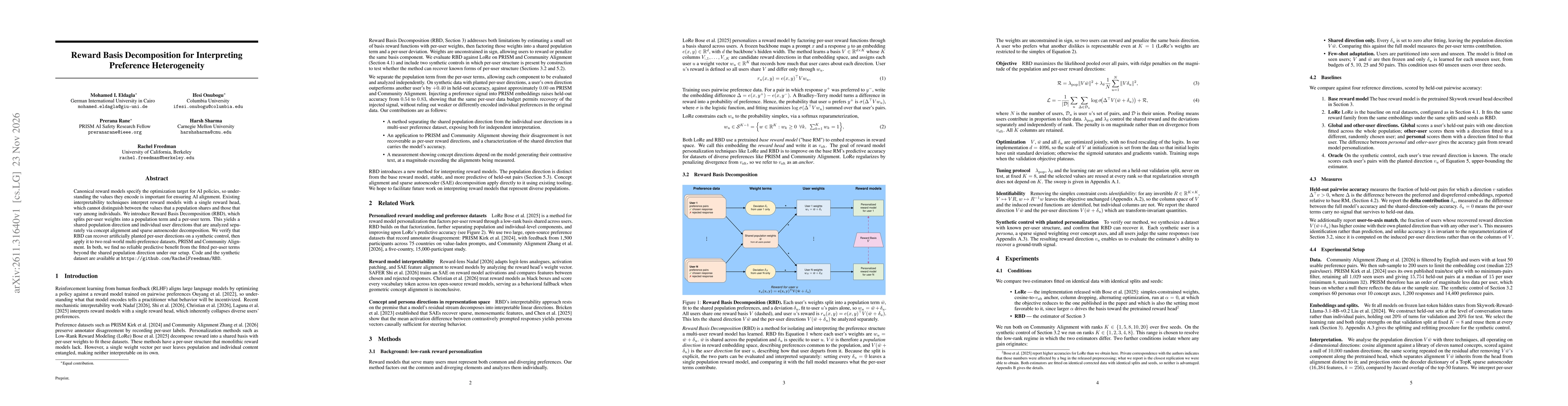
Canonical reward models specify the optimization target for AI policies, so understanding the values they encode is important for ensuring AI alignment. Existing interpretability techniques interpret reward models with a single reward head, which cannot distinguish between the values that a population shares and those that vary among individuals. We introduce Reward Basis Decomposition (RBD), which splits per-user weights into a population term and a per-user term. This yields a shared population direction and individual user directions that are analyzed separately via concept alignment and sparse autoencoder decomposition. We verify that RBD can recover artificially planted per-user directions on a synthetic control, then apply it to two real-world multi-preference datasets, PRISM and Community Alignment. In both, we find no individual-user structure, suggesting that a single direction in the reward embedding space accounts for most preferences. We verify that RBD can recover artificially planted per-user directions on a synthetic control, then apply it to two real-world multi-preference datasets, PRISM and Community Alignment. In both, we find no reliable predictive benefit from the fitted per-user terms beyond the shared population direction under our setup. Code and the synthetic dataset are available at https://github.com/RachelFreedman/RBD.
AI Key Findings
Get AI-generated insights about this paper's methodology, results, significance, and more — available when analysis has been generated.
Discussion 0