Risk-Aware Semantic Grounding for Trustworthy LLM-Based Robot Planning
Abstract
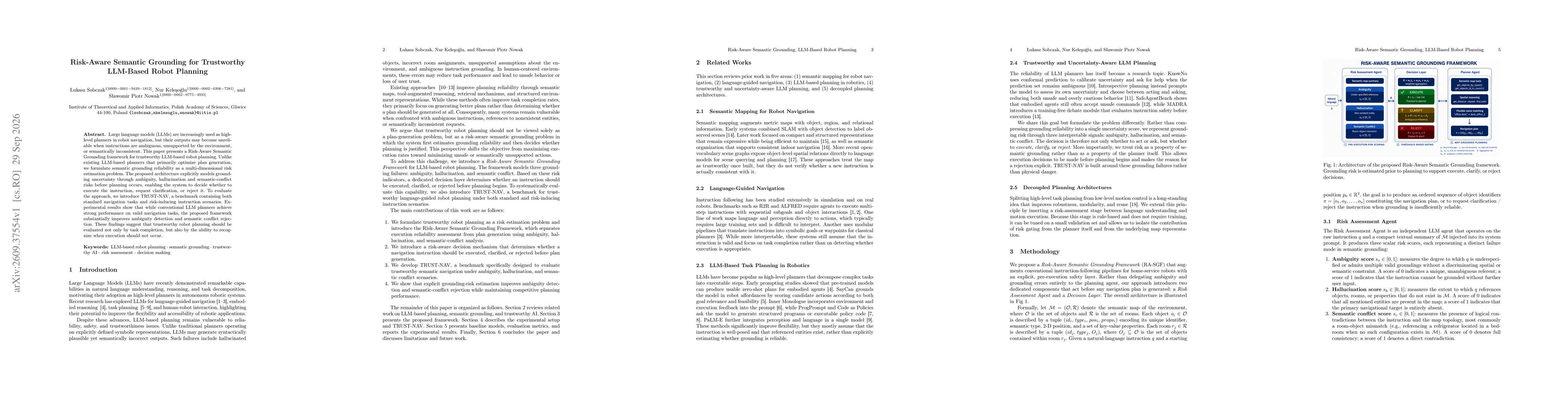
Large language models (LLMs) are increasingly used as high-level planners in robot navigation, but their outputs may become unreliable when instructions are ambiguous, unsupported by the environment, or semantically inconsistent. This paper presents a Risk-Aware Semantic Grounding framework for trustworthy LLM-based robot planning. Unlike existing LLM-based planners that primarily optimize plan generation, we formulate semantic grounding reliability as a multi-dimensional risk estimation problem. The proposed architecture explicitly models grounding uncertainty through ambiguity, hallucination and semantic-conflict risks before planning occurs, enabling the system to decide whether to execute the instruction, request clarification, or reject it. To evaluate the approach, we introduce TRUST-NAV, a benchmark containing both standard navigation tasks and risk-inducing instruction scenarios. Experimental results show that while conventional LLM planners achieve strong performance on valid navigation tasks, the proposed framework substantially improves ambiguity detection and semantic conflict rejection. These findings suggest that trustworthy robot planning should be evaluated not only by task completion, but also by the ability to recognize when execution should not occur.
AI Key Findings
Get AI-generated insights about this paper's methodology, results, significance, and more — available when analysis has been generated.
Discussion 0